What Is a Data Breach? Meaning, Causes, Examples & Prevention (2026)
Learn what a data breach is, how it happens, real-world examples like Yahoo and Equifax, its impact, and practical tips to protect your personal information.
What Is a Data Breach? Meaning, Causes, Real Examples, and Prevention
What Is a Data Breach?
Imagine waking up one morning to find that someone has secretly entered your house. They didn't steal your TV or furniture, but they quietly copied your passport, bank statements, family photos, personal diary, and every important document you own. They then left without leaving any obvious signs behind.
That is very similar to what happens during a data breach.
In today's digital world, our personal information is stored everywhere. Banks store our financial records, hospitals keep our medical history, online shopping websites save our addresses and payment details, and social media platforms maintain our photos, messages, and personal profiles.
A data breach occurs when this sensitive or confidential information is accessed, copied, stolen, or exposed by someone who is not authorized to see it.
Unlike many cyberattacks that focus on disrupting systems or demanding ransom, the primary goal of a data breach is often to obtain valuable information. This stolen data can later be sold on dark web marketplaces, used for identity theft, financial fraud, phishing campaigns, corporate espionage, or other criminal activities.
Data breaches can affect anyone—from individual users and small businesses to multinational corporations and government agencies. In recent years, billions of personal records have been exposed through major breaches, making data protection one of the biggest challenges in cybersecurity.
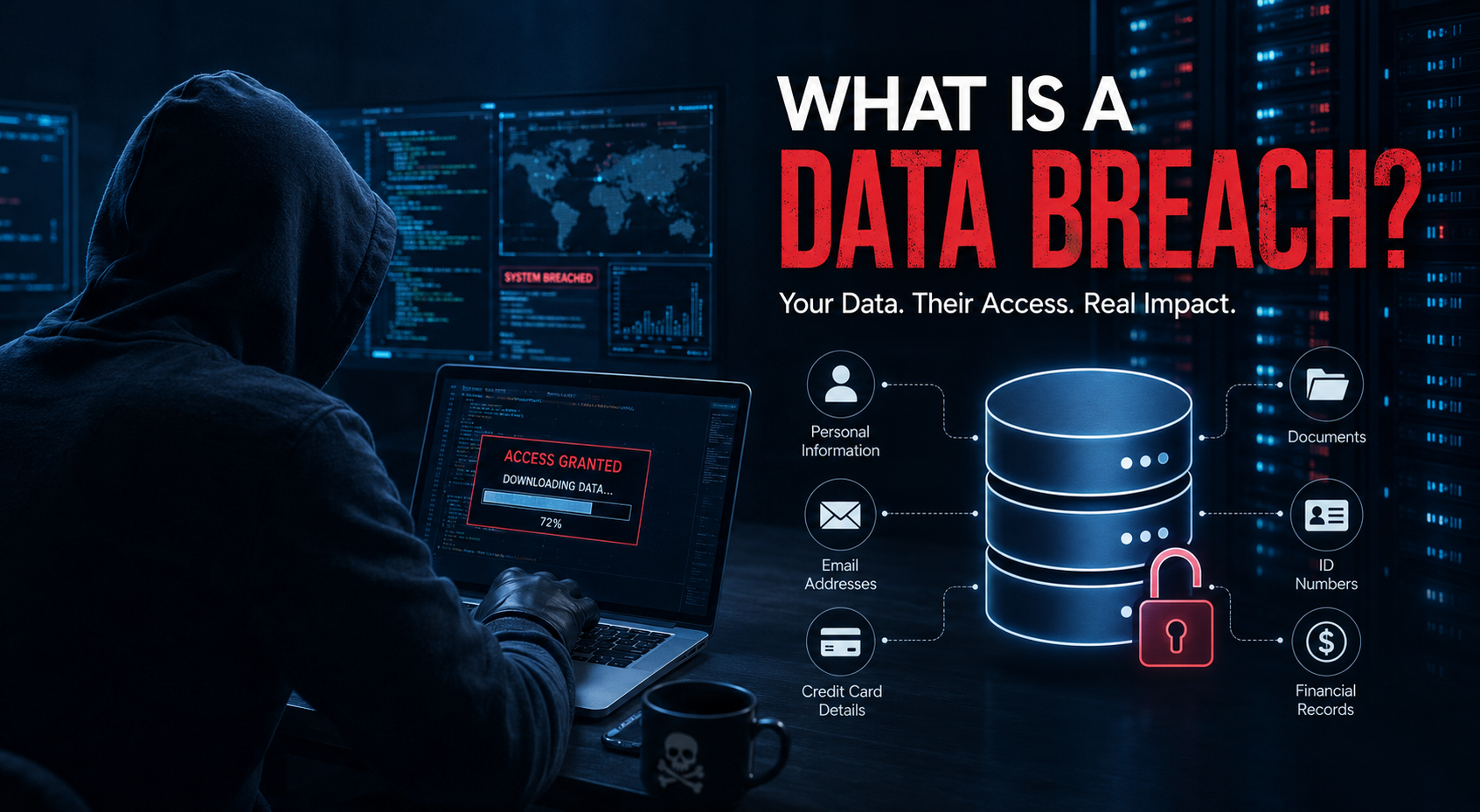
A Simple Real-Life Example
Imagine your school keeps every student's report card, address, phone number, and personal details inside a locked office.
Only the principal and authorized staff have the keys.
One night, someone secretly enters the office, copies every student record onto a USB drive, and leaves without taking any physical documents.
The next morning, everything appears normal. The files are still there, the cabinets are locked, and nothing seems missing.
However, someone now possesses confidential information that they were never supposed to have.
That is a data breach.
The important point is that the original data doesn't have to be deleted or changed. Simply accessing or copying sensitive information without permission is enough to be considered a data breach.
Data Breach vs Data Leak: What's the Difference?
Many people use the terms data breach and data leak interchangeably, but they are not exactly the same.
A data breach usually involves unauthorized access by an attacker. Hackers exploit vulnerabilities, steal login credentials, or use malware to gain access to confidential information.
A data leak, on the other hand, often happens accidentally. For example, a company might mistakenly leave a cloud storage bucket publicly accessible, allowing anyone on the internet to view confidential files without needing to hack into the system.
Both incidents expose sensitive information, but the cause is different.
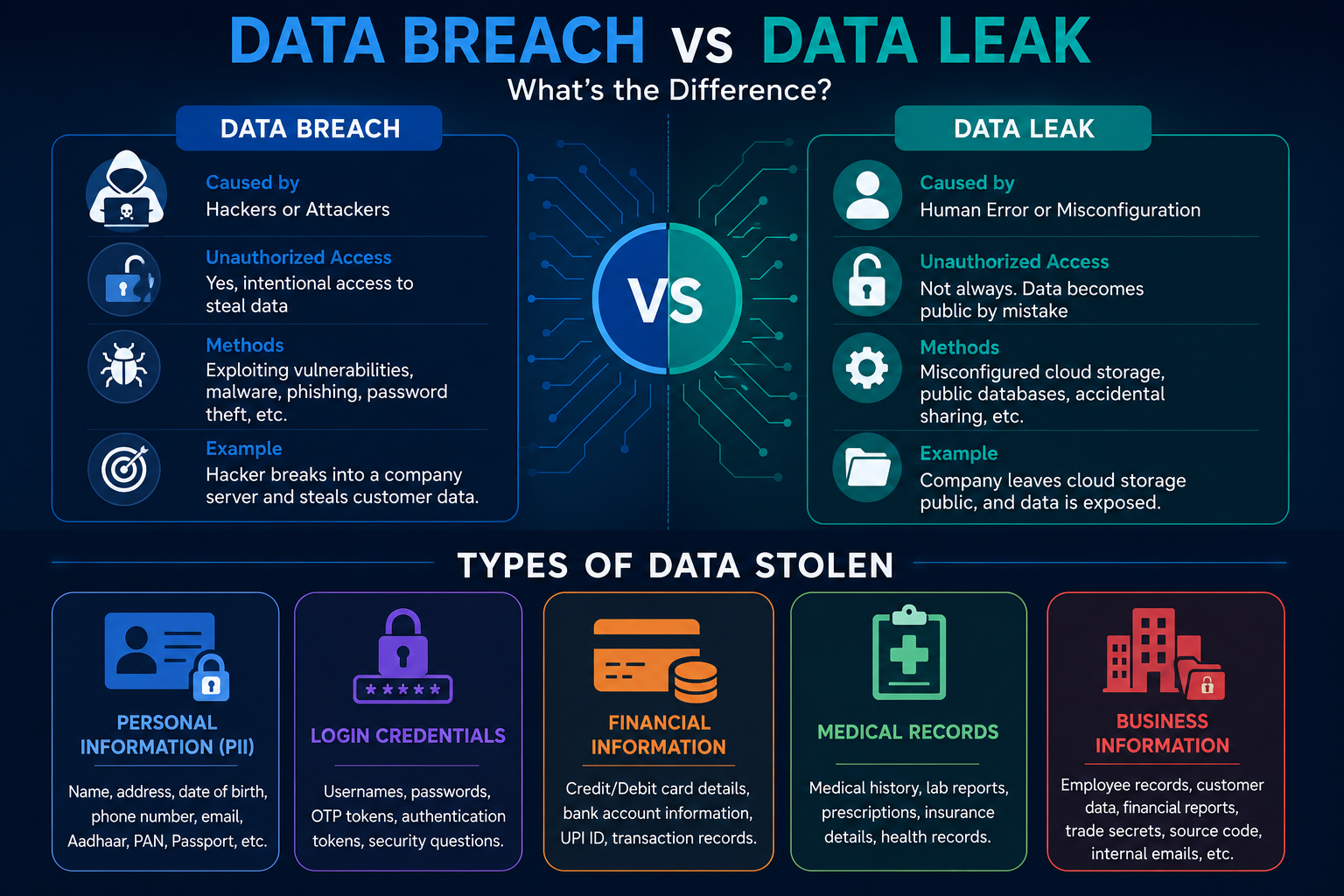
What Kind of Information Gets Stolen?
Not all stolen data has the same value. Cybercriminals target information that can be used to make money, impersonate victims, or launch future attacks.
Some of the most commonly stolen information includes:
Personal Information (Personally Identifiable Information - PII)
This includes information that can identify an individual, such as:
Full name
Date of birth
Home address
Phone number
Email address
Passport number
National ID or Social Security Number
This type of information is often used for identity theft and account verification fraud.
Login Credentials
Attackers frequently steal usernames, passwords, and authentication tokens.
If victims reuse the same password across multiple websites, criminals can gain access to email accounts, social media profiles, banking portals, and other online services.
Financial Information
Financial records are among the most valuable targets.
Examples include:
Credit card numbers
Debit card details
Bank account numbers
Online payment information
Billing addresses
This information can be used for unauthorized purchases, fraudulent transactions, or sold to other criminals.
Medical Records
Healthcare organizations store extremely sensitive information, including:
Medical history
Laboratory reports
Insurance information
Prescriptions
Patient identification numbers
Unlike passwords, medical records cannot simply be changed, making them particularly valuable on underground marketplaces.
Business Information
Companies may lose confidential information such as:
Employee records
Customer databases
Financial reports
Product designs
Trade secrets
Source code
Internal emails
These breaches can lead to financial losses, competitive disadvantages, and legal consequences.
Why Is Stolen Data So Valuable?
Many people believe their personal information isn't important because they don't have large amounts of money or hold influential positions.
However, cybercriminals think differently.
Even a simple combination of your name, email address, and phone number can be used to:
Launch convincing phishing attacks.
Reset passwords on online accounts.
Impersonate you during customer support calls.
Commit identity theft.
Apply for loans or financial services using stolen information.
Sell your data to other criminals on underground marketplaces.
For attackers, stolen information is a valuable commodity. A single breach involving millions of records can generate significant profits through fraud, extortion, and illegal data sales.
How Do Data Breaches Happen?
Many people imagine a hacker sitting in a dark room, typing rapidly as they break into a company's systems. While movies often portray cyberattacks this way, the reality is very different.
Most data breaches don't happen because hackers possess extraordinary skills. Instead, they succeed because someone made a mistake, a system wasn't updated, or a security weakness was left unprotected.
Cybercriminals are constantly searching for these weaknesses. Once they find one, they exploit it to gain unauthorized access to valuable information.
Let's look at the most common ways data breaches occur.
1. Phishing Attacks
Phishing is one of the most common causes of data breaches.
Instead of attacking computers directly, cybercriminals target people. They send fake emails, text messages, or websites that appear to come from trusted organizations such as banks, online shopping platforms, government agencies, or even a company's own IT department.
For example, an employee might receive an email saying:
"Your Microsoft 365 password will expire today. Click here to verify your account."
The email looks genuine, complete with the company's logo and professional formatting.
When the employee clicks the link, they are taken to a fake login page that looks identical to the real one. As soon as they enter their username and password, the information is sent directly to the attacker.
The employee believes they have logged in successfully, but the attacker now has their credentials and can access company systems.
A single successful phishing email can give attackers access to thousands or even millions of confidential records.
2. Weak or Reused Passwords
Passwords are often the first line of defense, but they are only effective if they are strong and unique.
Many people still use simple passwords such as:
123456passwordqwertyTheir birthdate
Their pet's name
Others reuse the same password across multiple websites.
Imagine you use the same password for an online shopping website and your email account. If the shopping website suffers a data breach, attackers may obtain your login credentials.
They will then try the same email address and password on other popular services such as Gmail, Facebook, Instagram, banking websites, or work accounts. This technique is known as credential stuffing.
If your passwords are reused, one breach can quickly lead to several compromised accounts.
3. Unpatched Software Vulnerabilities
Every software application contains bugs. Sometimes, these bugs create security vulnerabilities that attackers can exploit.
When software developers discover these vulnerabilities, they release security updates—commonly known as patches.
Problems arise when organizations delay installing those updates.
Cybercriminals actively search the internet for systems running outdated software. Once they find one, they can exploit the known vulnerability to gain unauthorized access.
One of the most famous examples is the Equifax data breach (2017). Attackers exploited a known vulnerability in the company's Apache Struts software—a security patch had already been released months earlier but had not been installed. As a result, the personal information of approximately 148 million people was exposed.
This incident demonstrated how a single missed update can lead to one of the largest data breaches in history.
4. Malware Infections
Malware is malicious software designed to infiltrate computers without the user's knowledge.
Common types of malware include:
Viruses
Worms
Trojans
Spyware
Ransomware
Malware often arrives through email attachments, infected websites, pirated software, or malicious downloads.
Once installed, it can silently monitor user activity, record keystrokes, steal passwords, capture screenshots, or create hidden access points for attackers.
Some malware remains hidden for months, continuously collecting sensitive information before transmitting it to cybercriminals.
5. Insider Threats
Not every data breach is caused by external hackers.
Sometimes, the threat comes from inside the organization.
An insider could be:
A current employee
A former employee
A contractor
A third-party vendor
A business partner
Insider threats may be intentional or accidental.
For example, an employee might intentionally steal customer information before leaving the company.
In another case, someone might accidentally email confidential files to the wrong recipient or upload sensitive documents to a publicly accessible cloud folder.
Even honest mistakes can expose thousands of confidential records.
6. Cloud Storage Misconfigurations
As organizations move their data to cloud platforms, configuration errors have become a major cause of data breaches.
Imagine storing important documents in an online folder but forgetting to set a password. Anyone with the link—or sometimes anyone on the internet—can access those files.
This is known as a cloud misconfiguration.
Over the years, numerous organizations have accidentally exposed customer databases, internal documents, financial reports, and personal information because cloud storage settings were configured incorrectly.
No hacking was required—the data was simply left publicly accessible.
7. Third-Party and Supply Chain Attacks
Modern businesses rely on many external companies for software, payment processing, cloud hosting, customer support, and IT management.
Attackers know that these third-party providers often have access to multiple organizations.
Instead of attacking the main company directly, cybercriminals compromise the supplier first.
When the trusted supplier distributes software updates or connects to customer systems, the attackers gain access as well.
The SolarWinds attack (2020) is one of the most well-known examples. Attackers secretly inserted malicious code into a legitimate software update, which was then downloaded by thousands of organizations worldwide, including government agencies and major corporations.
This demonstrated that even organizations with strong cybersecurity can become victims if one of their trusted partners is compromised.
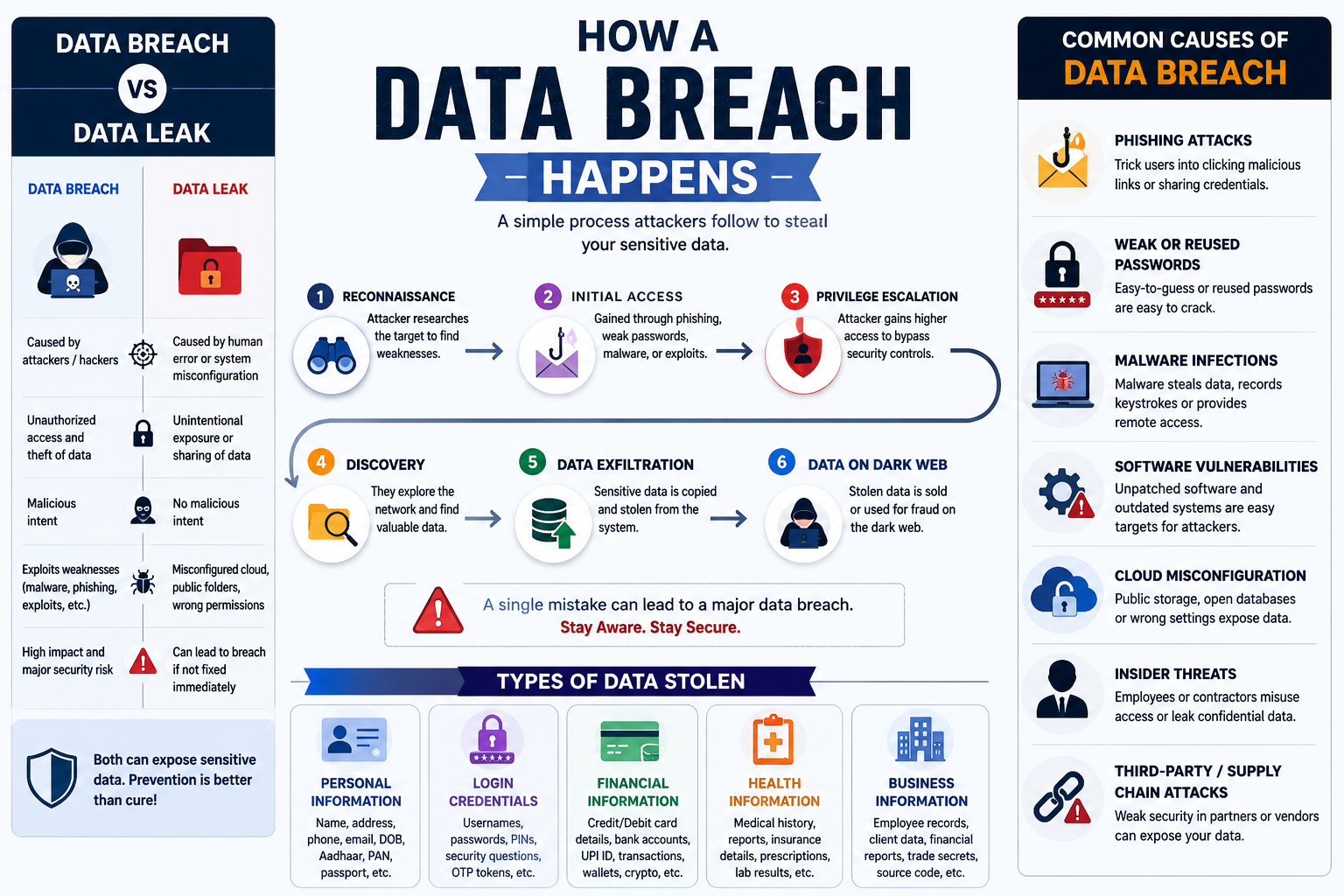
The Common Pattern Behind Most Data Breaches
Although every data breach is different, many share the same underlying causes:
Someone clicked a phishing email.
A weak password was guessed.
A security update was ignored.
Malware infected a computer.
Sensitive data was accidentally exposed.
A trusted supplier was compromised.
In most cases, the breach wasn't caused by a single dramatic event. Instead, it was the result of one small weakness that attackers successfully exploited.
Understanding these common causes is the first step toward preventing future data breaches.
Real-World Examples of Major Data Breaches
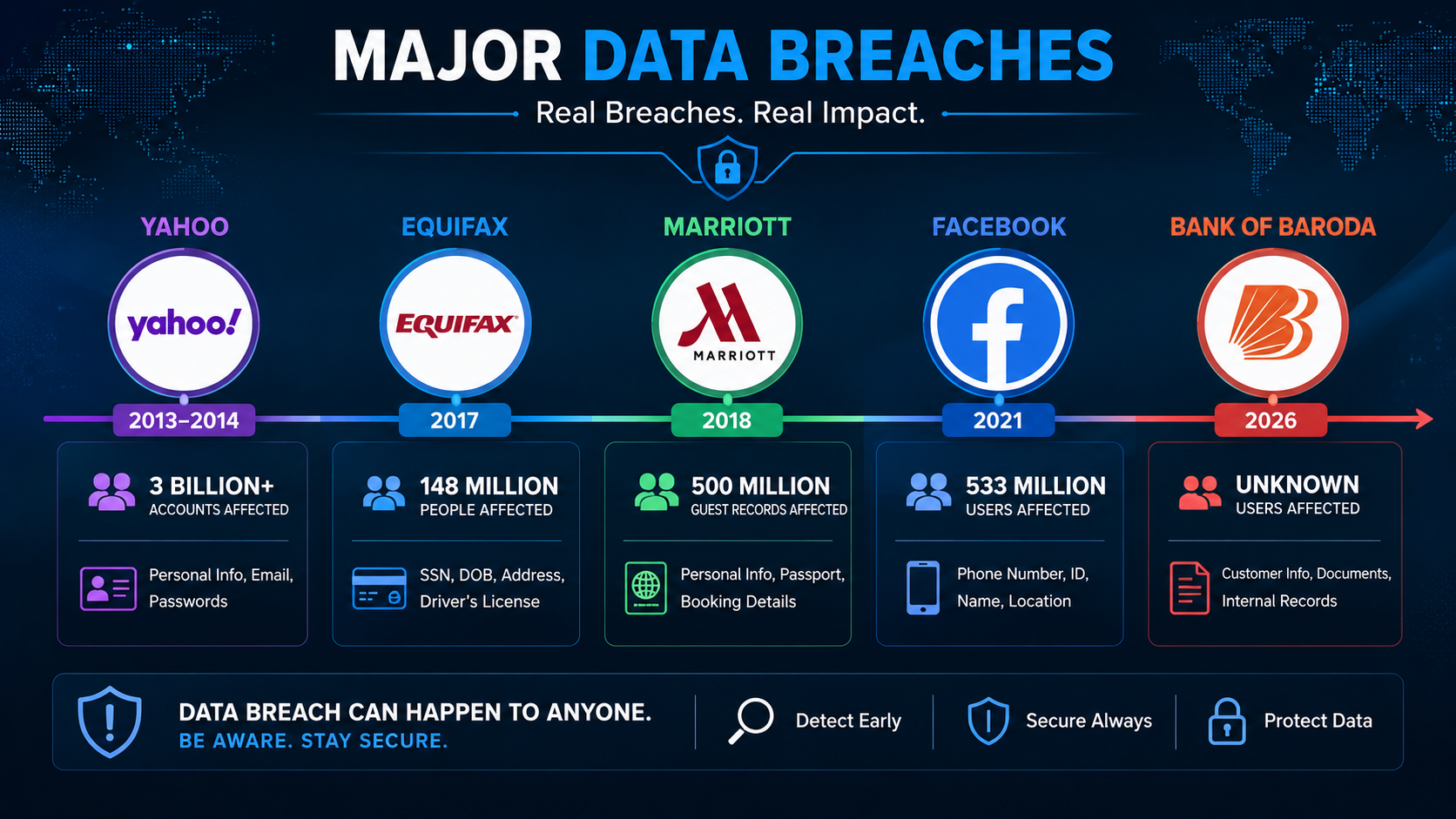
Over the past two decades, some of the world's largest organizations have suffered massive data breaches. These incidents affected billions of people, caused billions of dollars in financial losses, and permanently changed how businesses approach cybersecurity.
Each breach taught valuable lessons about the importance of strong security, timely software updates, employee awareness, and rapid incident response.
Let's look at some of the most significant data breaches in history.
1. Yahoo Data Breach (2013–2014)
The Yahoo data breach remains one of the largest in internet history.
Although the attacks occurred in 2013 and 2014, Yahoo revealed the full scale of the breach several years later during its acquisition by Verizon.
Hackers gained unauthorized access to Yahoo's user database and stole information belonging to approximately 3 billion user accounts.
The stolen information included:
Full names
Email addresses
Phone numbers
Dates of birth
Password hashes
Security questions and answers
Fortunately, Yahoo stated that bank account and payment card information were stored separately and were not compromised.
The breach significantly damaged Yahoo's reputation and reduced the company's acquisition value by hundreds of millions of dollars.
Key Lesson
Even technology giants can become victims of cyberattacks. Delayed detection and delayed disclosure often increase the overall damage.
2. Equifax Data Breach (2017)
Equifax is one of the largest credit reporting agencies in the United States.
In 2017, attackers exploited a known vulnerability in the Apache Struts web framework. Although a security patch had already been released, the company failed to install it in time.
As a result, attackers accessed the personal information of approximately 148 million people.
The compromised data included:
Full names
Social Security numbers
Dates of birth
Home addresses
Driver's license numbers
Some credit card information
Because much of this information is used for identity verification, millions of people faced long-term risks of identity theft and financial fraud.
Equifax later paid hundreds of millions of dollars in settlements and faced severe criticism for its security practices.
Key Lesson
Keeping software updated is one of the simplest and most effective ways to prevent data breaches.
3. Facebook Data Exposure (2021)
In 2021, personal information belonging to approximately 533 million Facebook users became publicly available online.
Unlike many traditional data breaches, attackers did not directly hack Facebook's internal servers. Instead, they abused a platform feature to collect publicly accessible profile information through automated data scraping.
The exposed information included:
Phone numbers
Facebook IDs
Full names
Locations
Birth dates
Email addresses (for some users)
Although passwords were not leaked, the exposed data became valuable for phishing campaigns, identity fraud, and social engineering attacks.
Key Lesson
Information that seems harmless on its own can become dangerous when collected at a massive scale.
4. Marriott International Data Breach (2018)
In 2018, Marriott International announced that attackers had compromised the reservation database of its Starwood hotel division.
Investigators later discovered that attackers had remained inside the network for several years before being detected.
Approximately 500 million guest records were affected.
The stolen information included:
Guest names
Phone numbers
Email addresses
Passport numbers
Reservation details
Travel history
Some customers also had encrypted payment card information exposed.
The breach became one of the largest hospitality-related cybersecurity incidents ever recorded.
Key Lesson
Organizations must continuously monitor their systems because attackers can remain hidden for months or even years before being discovered.
5. Bank of Baroda Data Leak (2026)
In July 2026, Bank of Baroda, one of India's largest public sector banks, confirmed a cybersecurity incident after customer data and internal documents were reportedly found on the dark web.
According to the bank, the incident began when attackers compromised an employee's email account. The bank clarified that its core banking systems were not breached, and normal banking operations continued while cybersecurity experts conducted a forensic investigation.
Reports suggested that the leaked information included:
Customer information
Identity documents
Loan-related records
Internal audit documents
At the time of reporting, the exact number of affected customers had not been officially confirmed.
The incident highlighted how attackers often target employees instead of attempting to break directly into highly protected banking systems.
Key Lesson
Cybersecurity is not only about protecting servers. Employee accounts, email security, multi-factor authentication (MFA), and security awareness training are equally important in preventing data breaches.
What Do These Data Breaches Have in Common?
Although these incidents involved different organizations and attack methods, they share several common patterns.
Sensitive customer data was stored in centralized databases.
Attackers exploited security weaknesses or abused existing features.
Several organizations detected the breach only after attackers had already accessed large amounts of information.
Millions of innocent users were affected, even though they had done nothing wrong.
The financial damage extended far beyond technical recovery, including legal penalties, regulatory fines, customer compensation, and loss of public trust.
The biggest lesson is that no organization is completely immune to a data breach. Whether it is a global technology company, a financial institution, a hotel chain, or a government agency, every organization that stores sensitive information must continuously invest in cybersecurity.
What Happens After a Data Breach?
A data breach doesn't end when hackers steal information.
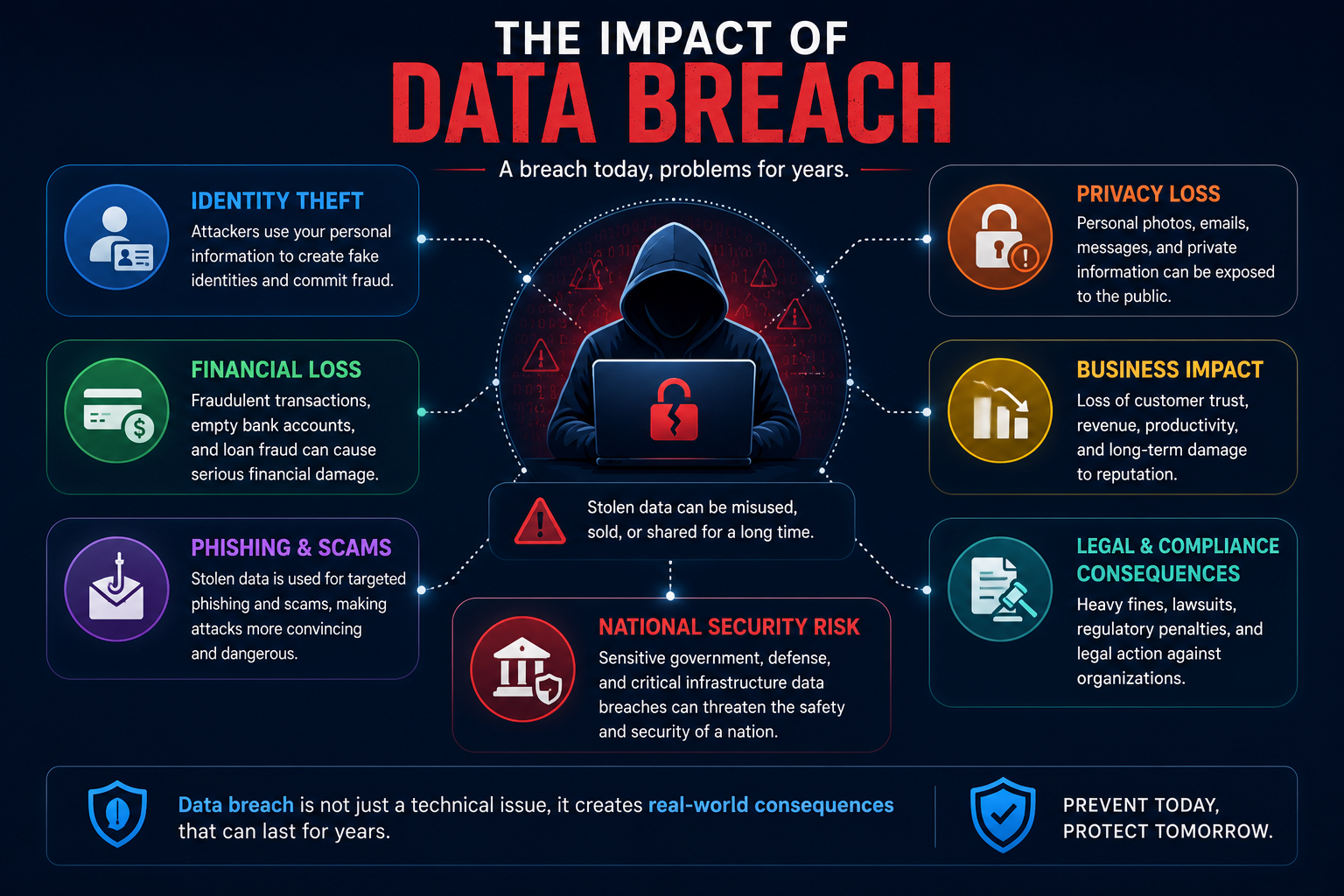
In many cases, the real damage begins after the data has been exposed. Stolen information can circulate on the dark web for years, where it is bought and sold by cybercriminals. Even if the affected company fixes its security issues, the leaked data may continue to be used for identity theft, scams, and financial fraud.
The consequences of a data breach can affect individuals, businesses, governments, and even entire economies.
Let's explore the impact in more detail.
1. Identity Theft
One of the most serious consequences of a data breach is identity theft.
When criminals obtain personal information such as your name, date of birth, national ID number, passport details, or driver's license, they may pretend to be you.
They can use your identity to:
Open bank accounts
Apply for loans
Register mobile phone numbers
Create fake online accounts
Commit fraud in your name
Victims often spend months or even years proving that they were not responsible for these fraudulent activities.
Example
Imagine someone steals your Aadhaar details, PAN number, and phone number. They may attempt to impersonate you during identity verification or use your information in financial scams.
2. Financial Loss
If banking information, credit card details, or online payment credentials are exposed, criminals may attempt unauthorized transactions.
Some common types of financial fraud include:
Unauthorized credit card purchases
Online banking fraud
Fake UPI payment requests
Investment scams
Loan fraud
Even when banks reverse fraudulent transactions, victims often experience stress, temporary financial loss, and the inconvenience of replacing cards or securing accounts.
3. Phishing and Online Scams
After a data breach, cybercriminals often launch targeted phishing campaigns.
Because they already know your personal information, their messages appear much more convincing.
For example, if attackers know:
Your full name
Your bank
Your phone number
Your email address
They can send personalized emails or SMS messages pretending to be your bank or another trusted organization.
Victims are more likely to trust these messages because they contain real personal information.
This type of attack is known as spear phishing, where attackers target specific individuals using previously stolen data.
4. Privacy Loss
Not every consequence is financial.
Sometimes the greatest loss is privacy.
Personal photos, emails, medical records, travel history, or private conversations may become accessible to unauthorized people.
Once personal information appears online, it can spread rapidly across websites, forums, and underground marketplaces.
Unlike a password, private information cannot simply be "changed."
This is why protecting personal data is so important.
5. Damage to Businesses
Organizations also suffer significant consequences after a data breach.
A single incident can result in:
Loss of customer trust
Negative media coverage
Legal action
Regulatory fines
Business disruption
Declining sales
Increased cybersecurity costs
Many organizations spend millions of dollars investigating the breach, notifying customers, improving security, and restoring their reputation.
For some small businesses, a major data breach can even threaten their survival.
6. Legal and Regulatory Consequences
Many countries have strict data protection laws that require organizations to safeguard customer information.
If a company fails to protect sensitive data, it may face:
Government investigations
Regulatory penalties
Lawsuits
Compensation claims
Mandatory security improvements
Examples include:
GDPR (General Data Protection Regulation) in the European Union.
CCPA (California Consumer Privacy Act) in the United States.
DPDP Act (Digital Personal Data Protection Act, 2023) in India, which establishes rules for handling and protecting personal data.
These laws encourage organizations to invest in stronger cybersecurity and handle customer information responsibly.
7. National Security Risks
Not every data breach affects only individuals or businesses.
When government agencies, defense organizations, or critical infrastructure are targeted, the consequences can extend to national security.
Sensitive government information may include:
Military data
Intelligence reports
Infrastructure plans
Citizen records
Diplomatic communications
If such information falls into the wrong hands, it can threaten public safety, national defense, and even international relations.
This is why governments invest heavily in cybersecurity and continuously monitor for cyber threats.
The Long-Term Impact
Many people assume that once a company announces a data breach, the problem is over.
Unfortunately, that is rarely the case.
Stolen information may remain available on cybercriminal forums for years. It can be sold repeatedly, combined with data from other breaches, and used in future scams.
For this reason, cybersecurity experts recommend that people continue monitoring their financial accounts, change passwords, and stay alert for suspicious activity long after a breach has occurred.
Key Takeaways
A data breach can lead to:
Identity theft
Financial fraud
Targeted phishing attacks
Loss of personal privacy
Business disruption
Legal penalties
National security concerns
The impact often extends far beyond the initial incident, affecting victims for months or even years.
How to Protect Yourself from a Data Breach
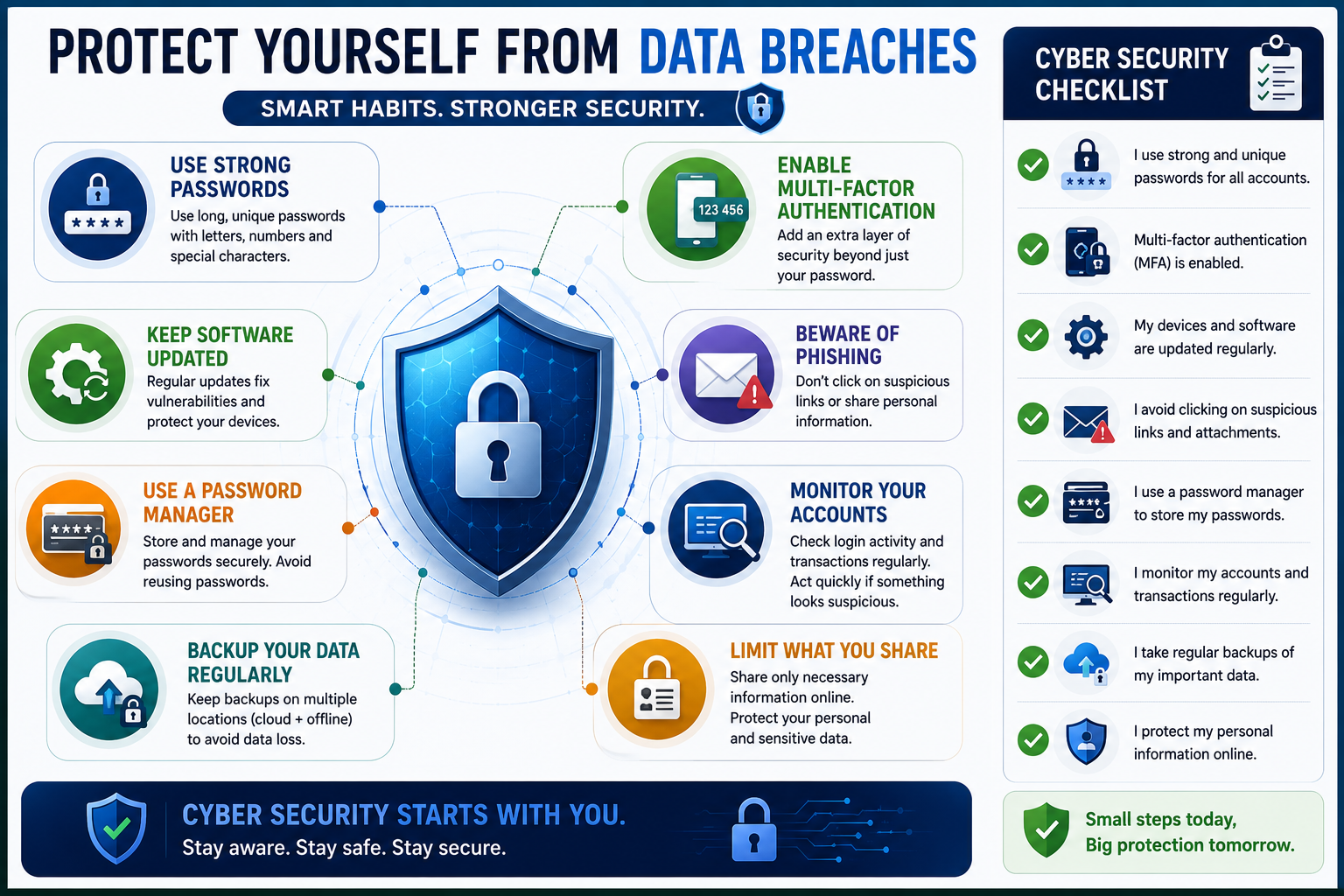
Although no one can completely eliminate the risk of a data breach, there are many simple steps you can take to reduce the chances of becoming a victim.
Cybersecurity is not just the responsibility of companies—it also depends on the everyday habits of users. Strong passwords, regular software updates, and awareness of online scams can significantly improve your digital security.
Here are some of the most effective ways to protect yourself.
1. Use Strong and Unique Passwords
Passwords are the first line of defense for your online accounts.
Avoid using weak passwords such as:
123456
password
qwerty
Your name
Your birthdate
Instead, create passwords that are:
At least 12–16 characters long
A mix of uppercase and lowercase letters
Include numbers and special characters
Unique for every website
For example:
❌ jayesh123
✅ J@y3sh!2026#Secure
If one website is breached, unique passwords ensure your other accounts remain protected.
2. Enable Multi-Factor Authentication (MFA)
A password alone is no longer enough.
Multi-Factor Authentication (MFA) adds an extra layer of security by requiring a second form of verification, such as:
A one-time code sent to your phone
An authentication app
A hardware security key
Your fingerprint or face recognition
Even if someone steals your password, they still cannot access your account without the second verification step.
Whenever possible, enable MFA for:
Email accounts
Banking apps
Social media
Cloud storage
Online shopping accounts
3. Keep Your Software Updated
Software updates are not just about adding new features.
Many updates contain security patches that fix vulnerabilities discovered by researchers.
Cybercriminals often target devices running outdated software because they know those security flaws have not been fixed.
Always keep updated:
Operating system
Web browser
Mobile apps
Antivirus software
Office applications
Enabling automatic updates is one of the easiest ways to stay protected.
4. Be Careful with Emails and Messages
Phishing remains one of the biggest causes of data breaches.
Before clicking any link or downloading an attachment, ask yourself:
Do I know the sender?
Is the email address genuine?
Is the message creating unnecessary urgency?
Does the website URL look correct?
If something feels suspicious, avoid clicking and verify the request through the organization's official website or customer support.
Remember:
Think before you click.
5. Use a Password Manager
Remembering dozens of strong passwords is almost impossible.
A password manager securely stores your passwords and can generate strong, unique passwords for every account.
Benefits include:
No need to remember every password
Strong passwords for every website
Protection against password reuse
Faster and safer logins
Using a password manager is much safer than writing passwords in a notebook or saving them in plain text files.
6. Monitor Your Accounts Regularly
Check your important accounts regularly for unusual activity.
Watch for:
Unknown login attempts
Password reset emails you didn't request
Unauthorized transactions
New devices connected to your account
The sooner suspicious activity is detected, the easier it is to limit the damage.
7. Check if Your Data Has Been Exposed
Several trusted online services allow you to check whether your email address has appeared in known data breaches.
If your information has been exposed:
Change your password immediately.
Enable Multi-Factor Authentication (MFA).
Avoid reusing the compromised password elsewhere.
Monitor your accounts for suspicious activity.
Finding out early can help prevent attackers from taking advantage of leaked credentials.
8. Avoid Sharing Too Much Personal Information Online
Every piece of information you share publicly can help cybercriminals build a profile about you.
Avoid publicly sharing:
Home address
Phone number
Personal identification documents
Travel plans
Financial information
Limiting personal information online makes phishing and identity theft more difficult.
9. Back Up Important Data
Although backups cannot prevent a data breach, they can reduce the impact of ransomware and accidental data loss.
Follow the 3-2-1 backup rule:
Keep 3 copies of your data.
Store them on 2 different types of storage.
Keep 1 copy offline or in a secure cloud location.
Regular backups ensure that your important files can be recovered if something goes wrong.
Quick Security Checklist
Before you leave, ask yourself these simple questions:
✅ Do I use a different password for every important account?
✅ Is Multi-Factor Authentication enabled on my email and banking apps?
✅ Are my devices updated with the latest security patches?
✅ Can I recognize a phishing email?
✅ Do I regularly check my bank statements and account activity?
✅ Do I keep backups of my important files?
If you answered "No" to any of these questions, today is a great time to improve your online security.
Conclusion
Data breaches have become one of the biggest cybersecurity challenges of the digital age. From global companies like Yahoo and Equifax to banks, hospitals, hotels, and government organizations, no system is completely immune to cyber threats.
While organizations must invest in stronger security measures, individuals also play an important role in protecting their personal information. Simple habits—such as using strong passwords, enabling Multi-Factor Authentication (MFA), keeping software updated, and staying alert to phishing scams—can significantly reduce your risk.
Cybersecurity is not a one-time task but an ongoing process. As technology evolves, so do cybercriminals' methods. Staying informed and practicing good digital security habits is the best way to protect yourself, your data, and your online identity.
The goal is not to be afraid of technology but to use it safely and confidently.
Frequently Asked Questions (FAQ)
What is a data breach in simple words?
A data breach happens when someone gains unauthorized access to confidential information such as passwords, financial details, medical records, or personal data without permission.
What causes most data breaches?
The most common causes include phishing attacks, weak passwords, software vulnerabilities, malware, insider threats, and cloud misconfigurations.
Is a data breach the same as hacking?
Not always. Many data breaches result from hacking, but some occur because of human error, accidental exposure, or improperly configured systems.
What should I do if my data is leaked?
Immediately change your passwords, enable Multi-Factor Authentication (MFA), monitor your accounts for suspicious activity, and notify your bank or service provider if financial information may have been exposed.
Can data breaches be prevented?
No system can guarantee complete protection, but strong cybersecurity practices—such as timely software updates, employee training, encryption, and MFA—can greatly reduce the risk and impact of data breaches.
Written by
Jayesh Gavit
IT Engineer & Content Creator, JGblogs
IT engineer with a passion for technology and building things. Started JGblogs in 2026 to share information and make government schemes, jobs, and career guides accessible to every Indian — free, in their own language.
About the author →Article
Information Quality
Related articles
GPT-6 Astra: Everything You Need to Know About OpenAI’s New AI Model
6 September 2026·1,250 views