Data Analyst Roadmap 2026: Complete Beginner to Job Guide
Learn how to become a Data Analyst in 2026. Explore Excel, SQL, Python, Power BI, salary, projects, certifications, and career roadmap.
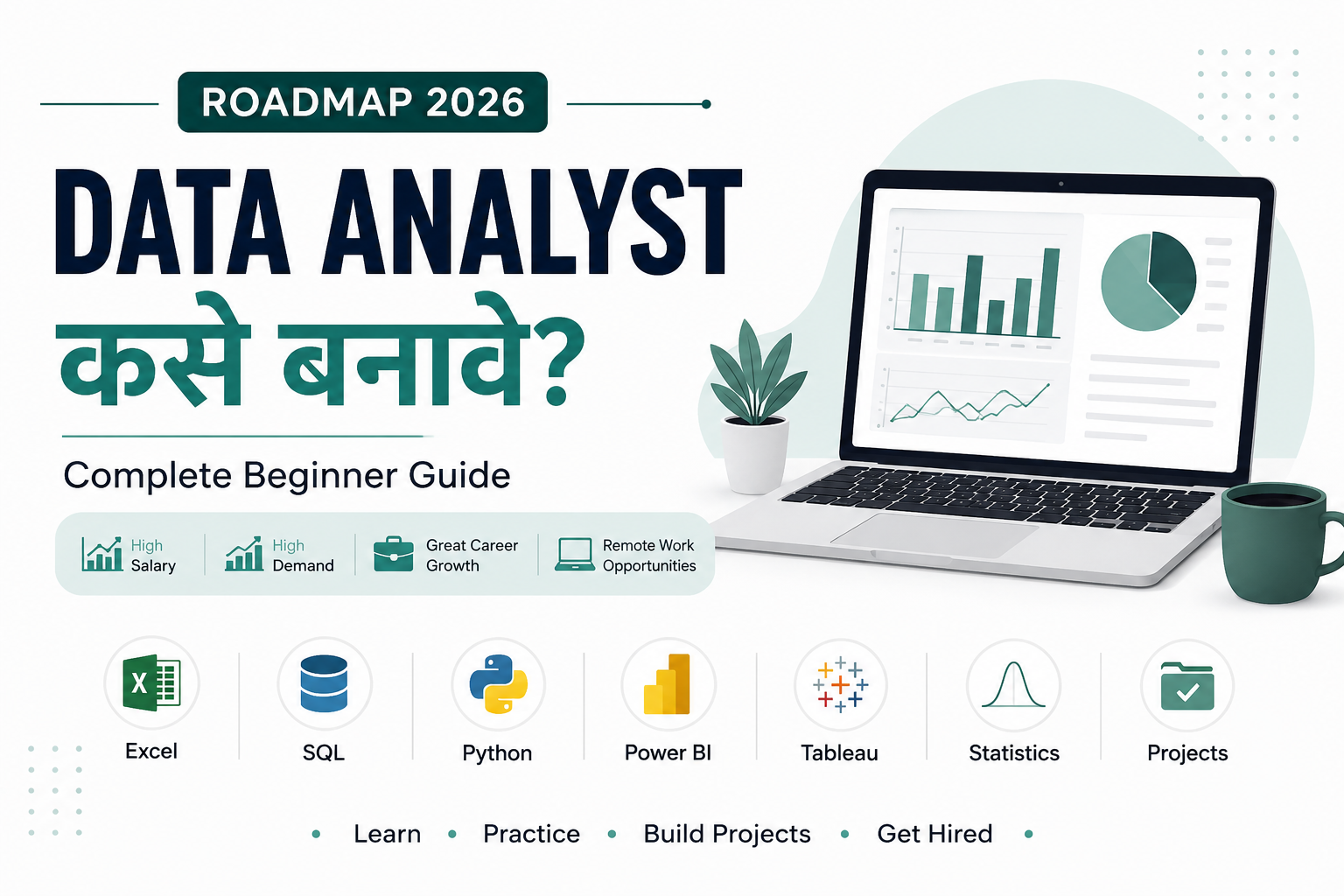
Data Analyst Roadmap 2026: Complete Beginner to Job Guide
Introduction
Data has become one of the most valuable assets for modern businesses. Every day, companies collect massive amounts of information from websites, mobile applications, social media platforms, sales systems, customer interactions, and business operations.
However, raw data alone has little value unless it can be analyzed and transformed into meaningful insights.
This is where Data Analysts play a crucial role.
Data Analysts help organizations understand trends, identify opportunities, solve business problems, and make data-driven decisions. As companies continue to rely on data for growth, the demand for skilled Data Analysts continues to increase worldwide.
Whether you are a student, fresher, working professional, or someone looking to switch careers, this guide will help you understand the skills, tools, salary expectations, and learning roadmap required to become a Data Analyst in 2026.
What is a Data Analyst?
A Data Analyst is a professional who collects, cleans, processes, analyzes, and visualizes data to help businesses make informed decisions.
Their primary goal is to convert complex datasets into meaningful information that stakeholders can understand and act upon.
Data Analysts work with:
Business Data
Sales Data
Marketing Data
Financial Data
Customer Data
Operational Data
They use tools such as:
Microsoft Excel
SQL
Python
Power BI
Tableau
to uncover insights and present findings through reports and dashboards.
Is Data Analytics a Good Career in 2026?
Yes.
Data Analytics continues to be one of the fastest-growing technology careers worldwide.
Organizations across every industry now rely on data to make strategic decisions.
Industries Hiring Data Analysts
Banking and Finance
Healthcare
E-Commerce
Retail
Information Technology
Manufacturing
Education
Government Organizations
Benefits of Becoming a Data Analyst
High demand globally
Attractive salary packages
Multiple career growth opportunities
Remote work opportunities
Strong transition path into Data Science and AI
Challenges
Continuous learning required
Data cleaning can be time-consuming
Strong analytical thinking is necessary
Despite these challenges, Data Analytics remains one of the most beginner-friendly technology careers.
Data Analyst vs Data Scientist
Many beginners confuse Data Analysts and Data Scientists.
Although both roles work with data, their responsibilities are different.
Data Analyst | Data Scientist |
|---|---|
Analyzes existing data | Builds predictive models |
Creates reports and dashboards | Develops machine learning solutions |
Uses Excel, SQL, Power BI | Uses Python, ML, AI, Statistics |
Focuses on business insights | Focuses on predictions and automation |
Easier entry-level opportunities | Requires deeper technical expertise |
For most beginners, becoming a Data Analyst is an excellent first step before exploring Data Science.
Data Analyst Salary in India
Data Analytics offers competitive salaries even for freshers.
Experience Level | Average Salary |
|---|---|
Fresher | ₹3-6 LPA |
1-3 Years | ₹5-10 LPA |
3-5 Years | ₹8-15 LPA |
Senior Data Analyst | ₹15-25 LPA+ |
Salary varies depending on:
Skills
Location
Company
Certifications
Projects
Industry
International opportunities often provide significantly higher compensation.
Step 1: Master Microsoft Excel
Many people underestimate Excel.
In reality, Excel remains one of the most important tools for Data Analysts.
Even large organizations use Excel extensively because it is simple, powerful, and widely accessible.
Excel Skills Every Data Analyst Should Learn
Basic Skills
Sorting Data
Filtering Data
Removing Duplicates
Conditional Formatting
Data Validation
Text to Columns
Intermediate Skills
VLOOKUP
XLOOKUP
INDEX and MATCH
IF Statements
COUNTIF
SUMIF
Advanced Skills
Pivot Tables
Pivot Charts
Dashboards
Macros
VBA Basics
Mastering Excel can significantly improve productivity and help you handle large datasets efficiently.
Step 2: Learn SQL
SQL (Structured Query Language) is one of the most important skills for Data Analysts.
Almost all business data is stored in databases.
Without SQL, it becomes difficult to access and analyze that data effectively.
SQL Topics to Learn
SELECT Statements
WHERE Clauses
ORDER BY
GROUP BY
HAVING
Joins
Subqueries
Aggregate Functions
Recommended Database
Beginners can start with:
MySQL
MySQL Workbench
Once you understand SQL fundamentals, learning PostgreSQL or Microsoft SQL Server becomes much easier.
Step 3: Learn Python
Excel is powerful, but eventually you will encounter datasets that are too large or complex.
Python helps automate repetitive tasks and perform advanced data analysis.
Python Topics to Learn
Variables
Loops
Functions
Lists
Dictionaries
File Handling
Important Libraries
Pandas
Used for:
Data Cleaning
Data Transformation
Data Analysis
NumPy
Used for:
Numerical Computations
Array Operations
Matplotlib
Used for:
Data Visualization
Graph Creation
Python allows analysts to process large datasets much faster than manual methods.
Step 4: Understand Statistics
You do not need a PhD in Mathematics.
However, a basic understanding of statistics is essential.
Important Topics
Mean
Median
Mode
Probability
Standard Deviation
Correlation
Sampling
These concepts help you interpret data accurately and avoid incorrect conclusions.
Step 5: Learn Power BI and Tableau
Businesses often prefer visual reports rather than spreadsheets.
Business Intelligence tools help transform data into easy-to-understand dashboards.
Power BI
Power BI has become one of the most popular BI tools.
Benefits include:
Microsoft Integration
AI Features
Interactive Dashboards
Strong Industry Adoption
Tableau
Tableau is known for:
Advanced Visualizations
User-Friendly Interface
Powerful Dashboarding Features
Learning both tools can significantly improve your employability.
What Data Analysts Actually Do in Companies
Many students believe Data Analysts spend their entire day creating charts and dashboards.
In reality, the role involves much more than visualization.
A Data Analyst acts as a bridge between business teams and technical teams.
Understanding Business Requirements
Before working with data, analysts often attend meetings with stakeholders to understand:
Business goals
Reporting requirements
Key performance indicators (KPIs)
Challenges faced by departments
Understanding the problem is often more important than writing queries.
Data Collection and Cleaning
Real-world data is rarely clean.
Data Analysts spend a significant amount of time:
Removing duplicate records
Fixing incorrect values
Handling missing data
Standardizing formats
Clean data is essential for accurate analysis.
Building Reports and Dashboards
After cleaning and analyzing data, analysts create:
Daily Reports
Weekly Reports
Executive Dashboards
Performance Dashboards
KPI Dashboards
These reports help decision-makers understand business performance.
Presenting Insights
One of the most important responsibilities of a Data Analyst is explaining data to non-technical stakeholders.
A good analyst does not simply show charts.
They answer questions such as:
Why are sales decreasing?
Which marketing campaign performs best?
Which products generate the highest profit?
What customer behavior trends are emerging?
Communication skills are often as important as technical skills.
AI Tools Every Data Analyst Should Know
Artificial Intelligence is transforming data analytics workflows.
Modern analysts use AI tools to increase productivity and automate repetitive tasks.
ChatGPT
Useful for:
SQL query generation
Python code assistance
Formula explanations
Data analysis guidance
Microsoft Copilot
Useful for:
Excel automation
Data summarization
Dashboard assistance
Quadratic
Quadratic combines spreadsheet functionality with AI-powered data analysis.
Users can analyze datasets using natural language instructions.
Google Gemini
Helpful for:
Data interpretation
Report drafting
Data summarization
AI tools should improve productivity, but they should never replace understanding the fundamentals.
Projects Every Beginner Should Build
Projects help demonstrate practical skills and make your resume stand out.
Sales Dashboard Project
Skills Used:
Excel
Power BI
Data Visualization
Customer Segmentation Analysis
Skills Used:
SQL
Data Cleaning
Business Insights
E-Commerce Analytics Dashboard
Skills Used:
Power BI
Tableau
KPI Tracking
Netflix Data Analysis Project
Skills Used:
Python
Pandas
Data Visualization
Employee Performance Dashboard
Skills Used:
SQL
Power BI
Reporting
Publishing projects on GitHub significantly improves your portfolio.
Build a Strong Portfolio
A portfolio is often more valuable than certifications.
Your portfolio should include:
GitHub Profile
Upload:
SQL Projects
Python Projects
Dashboards
Data Analysis Reports
LinkedIn Profile
Include:
Skills
Projects
Certifications
Learning Journey
Portfolio Website
Create a simple portfolio showcasing:
Projects
Dashboards
Case Studies
Contact Information
Recruiters often review portfolios before scheduling interviews.
Certifications Worth Considering
Certifications can strengthen your profile but should not replace practical skills.
Microsoft Power BI Data Analyst Associate
One of the most respected certifications for Power BI professionals.
Google Data Analytics Professional Certificate
Beginner-friendly certification.
IBM Data Analyst Professional Certificate
Good option for beginners entering the field.
Microsoft Excel Certification
Useful for demonstrating spreadsheet expertise.
Remember:
Practical projects combined with certifications provide the strongest combination.
Common Mistakes Beginners Make
Skipping Excel
Many beginners jump directly to Python and ignore Excel.
Excel remains heavily used in businesses.
Avoiding SQL
SQL is one of the most important skills for Data Analysts.
Learning Too Many Tools
Master a few tools first rather than learning many tools superficially.
Ignoring Business Knowledge
Data analysis is about solving business problems, not just creating charts.
Not Building Projects
Projects demonstrate practical skills better than certificates alone.
12-Month Data Analyst Learning Roadmap
Months 1-3
Excel Fundamentals
Basic Statistics
Data Cleaning
Months 4-6
SQL
Database Concepts
Advanced Excel
Months 7-9
Python
Pandas
NumPy
Data Visualization
Months 10-12
Power BI
Tableau
Portfolio Building
Job Applications
Following a structured learning path helps avoid confusion and keeps progress consistent.
Frequently Asked Questions
Can I become a Data Analyst without a degree?
Yes. While degrees can help during the hiring process, practical skills and projects are often more important.
Is coding required for Data Analytics?
Basic Python knowledge is recommended but advanced software engineering skills are not necessary.
How long does it take to become a Data Analyst?
Most beginners can become job-ready within 6 to 12 months of focused learning.
Which tool should I learn first?
Microsoft Excel should be your starting point.
Is Data Analytics a good career in India?
Yes. Demand for Data Analysts continues to grow across industries.
Which is better: Power BI or Tableau?
Both are valuable. Power BI is often preferred because of its integration with the Microsoft ecosystem.
Final Thoughts
Data Analytics is one of the most promising career paths in 2026. Companies increasingly rely on data to make decisions, optimize operations, and improve customer experiences.
Success in this field does not require genius-level mathematics or advanced programming skills. Instead, it requires consistency, curiosity, problem-solving ability, and practical experience.
Start with Excel, learn SQL, understand statistics, build Python skills, master Power BI, and create real-world projects.
If you follow this roadmap consistently, you can build a strong foundation and significantly improve your chances of landing your first Data Analyst job in 2026.
Written by
Jayesh Gavit
IT Engineer & Content Creator, JGblogs
IT engineer with a passion for technology and building things. Started JGblogs in 2026 to share information and make government schemes, jobs, and career guides accessible to every Indian — free, in their own language.
About the author →Article
Related articles
How to Get Your First Cybersecurity Job in 2026: Complete Beginner Roadmap
7 June 2026·1,250 views
Jobs That May Grow Fast in India by 2030: Top Careers, Skills, Salary & Future Trends
24 May 2026·1,250 views
Best Skills to Learn During College in 2026 for Better Career Opportunities
24 May 2026·1,250 views