How to Get Your First Cybersecurity Job in 2026: Complete Beginner Roadmap
Learn how to get your first cybersecurity job in 2026. Explore skills, certifications, projects, salary, career paths, and expert tips.
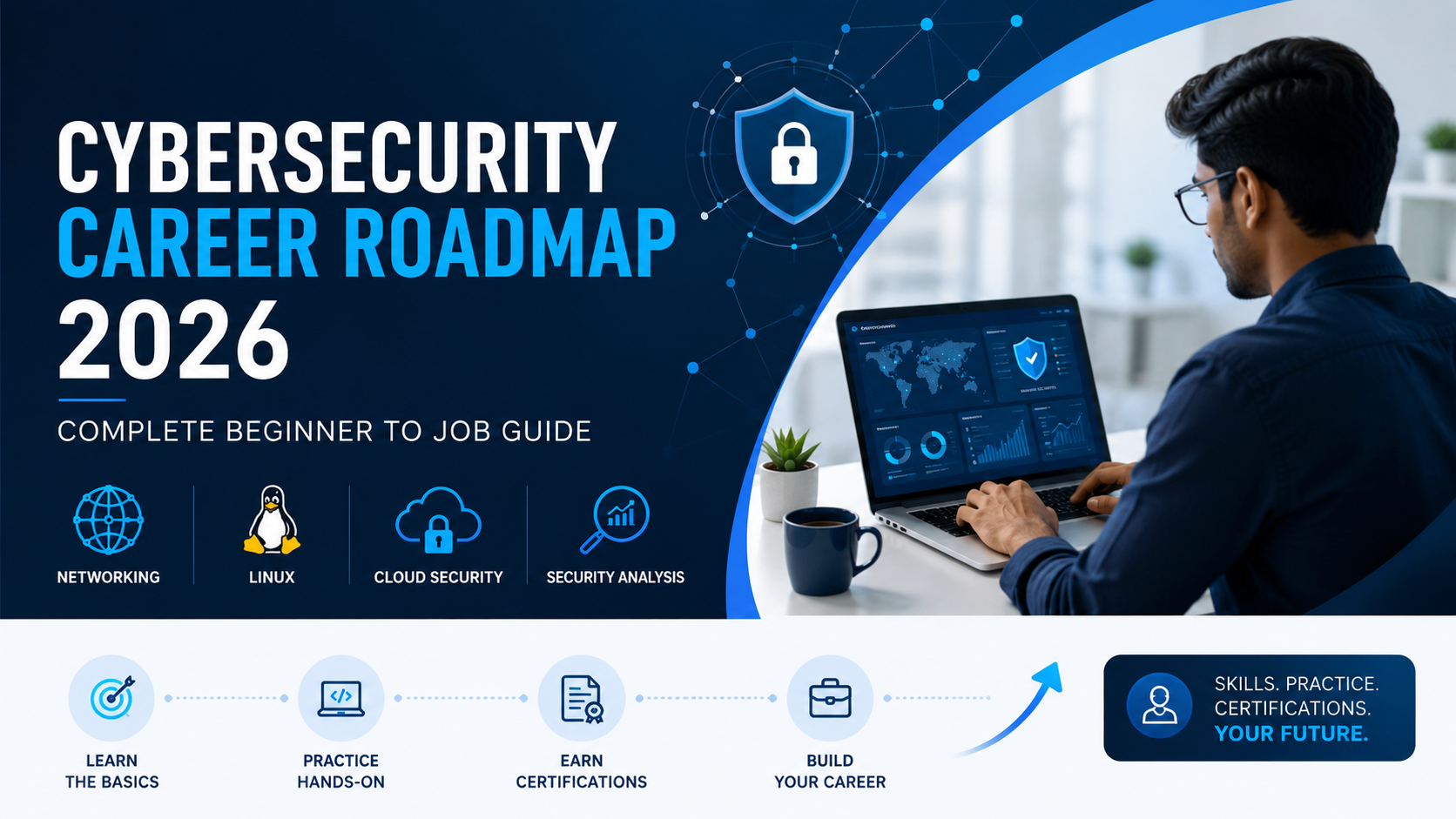
How to Get Your First Cybersecurity Job in 2026: A Complete Beginner's Roadmap
Introduction
Cybersecurity is one of the fastest-growing technology careers in the world. With organizations facing increasing cyber threats, cloud security challenges, ransomware attacks, and AI-powered attacks, companies are actively searching for skilled cybersecurity professionals.
However, getting your first cybersecurity job in 2026 is very different from what it was a few years ago.
Many beginners believe that completing a few online courses and earning certifications will guarantee a job. Unfortunately, that is no longer true. Companies now want practical skills, real-world problem-solving ability, communication skills, and proof that you can actually perform security work.
This guide explains a realistic roadmap for students and freshers who want to start a cybersecurity career and secure their first job.
Is Cybersecurity a Good Career in 2026?
Yes.
Cybersecurity continues to be one of the most in-demand technology fields globally. Every organization that uses computers, cloud platforms, websites, applications, or digital payments requires security professionals.
Industries hiring cybersecurity professionals include:
Banking and Financial Services
Government Organizations
Healthcare
E-commerce
SaaS Companies
Cloud Providers
Consulting Firms
Benefits of a Cybersecurity Career
Strong demand worldwide
Good salary growth
Multiple career paths
Remote work opportunities
Continuous learning and innovation
Challenges
Continuous skill development
Competitive entry-level market
Rapidly changing technologies
Practical skills required
Understanding Cybersecurity Career Paths
One of the biggest mistakes beginners make is trying to learn everything at once.
Cybersecurity contains many domains, but beginners should focus on one path first.
SOC Analyst (Blue Team)
SOC Analysts help organizations monitor, detect, and respond to cyber threats.
Responsibilities include:
Monitoring security alerts
Log analysis
Threat detection
Incident response
Security monitoring
Penetration Tester (Red Team)
Penetration Testers simulate attacks to identify vulnerabilities before attackers can exploit them.
Responsibilities include:
Web application testing
Network testing
Security assessments
Vulnerability analysis
Security reporting
Which Path Should Beginners Choose?
For freshers, SOC Analyst roles often provide more entry-level opportunities. Penetration Testing roles can be more competitive and usually require deeper technical knowledge.
Step 1: Learn Networking Fundamentals
Networking is the backbone of cybersecurity.
Without understanding networking, it becomes difficult to understand how attacks happen and how systems communicate.
Important topics include:
IP Addressing
DNS
TCP/IP
HTTP and HTTPS
Routing
Firewalls
VPNs
A strong understanding of networking helps in both SOC and Penetration Testing careers.
Step 2: Learn Linux and Operating Systems
Most cybersecurity tools and environments rely heavily on Linux.
Important Linux concepts include:
File permissions
User management
Command line navigation
Networking commands
Package management
Recommended distributions:
Ubuntu
Kali Linux
Learning Linux also improves troubleshooting and system administration skills.
Step 3: Learn Basic Scripting
You do not need to become a software engineer.
However, basic scripting is extremely useful.
Recommended languages:
Python
Bash
PowerShell
Scripting helps automate repetitive tasks and improves efficiency during security assessments.
Step 4: Understand Security Fundamentals
Before using advanced tools, learn the concepts behind cybersecurity.
Topics include:
Authentication
Authorization
Encryption
Vulnerability Management
Risk Assessment
Security Monitoring
Incident Response
Understanding the "why" behind security controls is often more important than memorizing definitions.
Step 5: Gain Practical Experience
Practical skills matter more than theory.
Many candidates complete multiple certifications but struggle during technical interviews because they lack hands-on experience.
Recommended Learning Platforms
TryHackMe
Provides beginner-friendly cybersecurity labs.
Hack The Box
Offers practical security challenges.
PortSwigger Web Security Academy
Excellent resource for web application security.
Projects You Can Build
Port Scanner
Password Generator
Log Analyzer
Vulnerability Scanner
Security Monitoring Dashboard
Publish your projects on GitHub to create a professional portfolio.
What Cybersecurity Professionals Actually Do in Companies
Many students imagine cybersecurity professionals spending the entire day hacking websites.
The reality is very different.
Cybersecurity professionals often spend a significant amount of time communicating with clients, understanding requirements, auditing systems, reviewing configurations, and preparing reports.
Client Requirement Gathering
Before security testing begins, teams typically conduct meetings with clients to understand:
Scope of testing
Applications to be tested
Authorized domains
Credentials provided for testing
Testing timelines
Compliance requirements
Understanding client requirements is a critical part of professional security work.
Web Application Security Testing
Security teams regularly test:
Websites
Customer portals
Admin panels
Login systems
Internal applications
The goal is to identify vulnerabilities such as:
SQL Injection
Cross-Site Scripting (XSS)
Authentication Issues
Authorization Flaws
Security Misconfigurations
Firewall and Security Configuration Reviews
Organizations rely heavily on firewalls for protection.
Security professionals often review:
Firewall rules
Open ports
Network segmentation
Access control configurations
Incorrect configurations can expose critical systems to attackers.
Security Audits
Cybersecurity teams perform audits to evaluate security controls and identify weaknesses.
These audits may include:
Password policies
User access reviews
Infrastructure assessments
Security controls validation
Compliance checks
Reporting and Recommendations
Finding vulnerabilities is only one part of the job.
Professionals must also:
Document findings
Explain risks
Recommend solutions
Present reports to clients
Strong communication skills are often just as important as technical skills.
Build a Strong Online Presence
Recruiters often evaluate candidates online before scheduling interviews.
Maintain:
Professional photo
Clear headline
Skills section
Projects
Certifications
Share your learning journey and cybersecurity insights regularly.
GitHub
Upload:
Security tools
Scripts
Projects
Write-ups
A strong GitHub profile demonstrates practical skills.
Certifications Worth Considering
Certifications can help strengthen your resume but should never replace practical experience.
Beginner-Friendly Certifications
ISC2 Certified in Cybersecurity (CC)
Good starting certification.
CompTIA Security+
Popular entry-level cybersecurity certification.
eJPT
Recommended for aspiring penetration testers.
Important Advice
One certification supported by practical projects is often more valuable than multiple certifications without hands-on experience.
Common Mistakes Beginners Make
Learning Too Many Things at Once
Focus on one cybersecurity path initially.
Ignoring Networking Fundamentals
Networking knowledge is essential.
Collecting Certificates Without Practice
Practical experience matters.
Not Building Projects
Projects demonstrate real skills.
Giving Up Too Early
Cybersecurity requires patience and consistent learning.
Cybersecurity Learning Roadmap (12 Months)
Months 1-3
Networking Basics
Linux Fundamentals
Command Line Skills
Months 4-6
Security Fundamentals
Python Basics
Choose SOC or Penetration Testing
Months 7-9
Practical Labs
Projects
GitHub Portfolio
Months 10-12
Certification
Resume Building
LinkedIn Optimization
Job Applications
Studying consistently for 2-3 hours daily can help build a strong foundation.
Cybersecurity Salary in India
Role | Experience | Approximate Salary |
|---|---|---|
SOC Analyst | Fresher | ₹4-8 LPA |
Security Analyst | 1-3 Years | ₹6-12 LPA |
Penetration Tester | 1-3 Years | ₹6-15 LPA |
Cloud Security Engineer | 3-5 Years | ₹12-25 LPA |
Salary varies depending on skills, certifications, experience, and location.
Frequently Asked Questions
Can freshers get cybersecurity jobs in 2026?
Yes. However, practical skills and projects are becoming increasingly important.
Is coding mandatory for cybersecurity?
Basic scripting knowledge is highly recommended but not mandatory for all roles.
Which certification is best for beginners?
ISC2 CC, Security+, and eJPT are excellent starting points.
How long does it take to become job-ready?
Most beginners can become job-ready within 6-12 months of focused learning and practice.
Is cybersecurity a good career in India?
Yes. Demand for cybersecurity professionals continues to grow across multiple industries.
Final Thoughts
Cybersecurity is not a shortcut to a high-paying job. Success requires strong fundamentals, practical experience, projects, communication skills, and continuous learning.
The professionals who succeed are not necessarily the ones with the most certifications. They are the ones who can solve problems, communicate effectively, demonstrate practical skills, and adapt to new challenges.
If you focus on networking, Linux, security fundamentals, hands-on labs, and project building, you can create a strong foundation and significantly improve your chances of securing your first cybersecurity job in 2026.
Written by
Jayesh Gavit
IT Engineer & Content Creator, JGblogs
IT engineer with a passion for technology and building things. Started JGblogs in 2026 to share information and make government schemes, jobs, and career guides accessible to every Indian — free, in their own language.
About the author →Article
Related articles
Jobs That May Grow Fast in India by 2030: Top Careers, Skills, Salary & Future Trends
24 May 2026·1,250 views
Best Skills to Learn During College in 2026 for Better Career Opportunities
24 May 2026·1,250 views