GPT-6 Astra: Everything You Need to Know About OpenAI’s New AI Model
GPT-6 Astra is OpenAI’s latest AI model for advanced reasoning, coding, research and computer use. Here’s what Astra can do and why it matters.
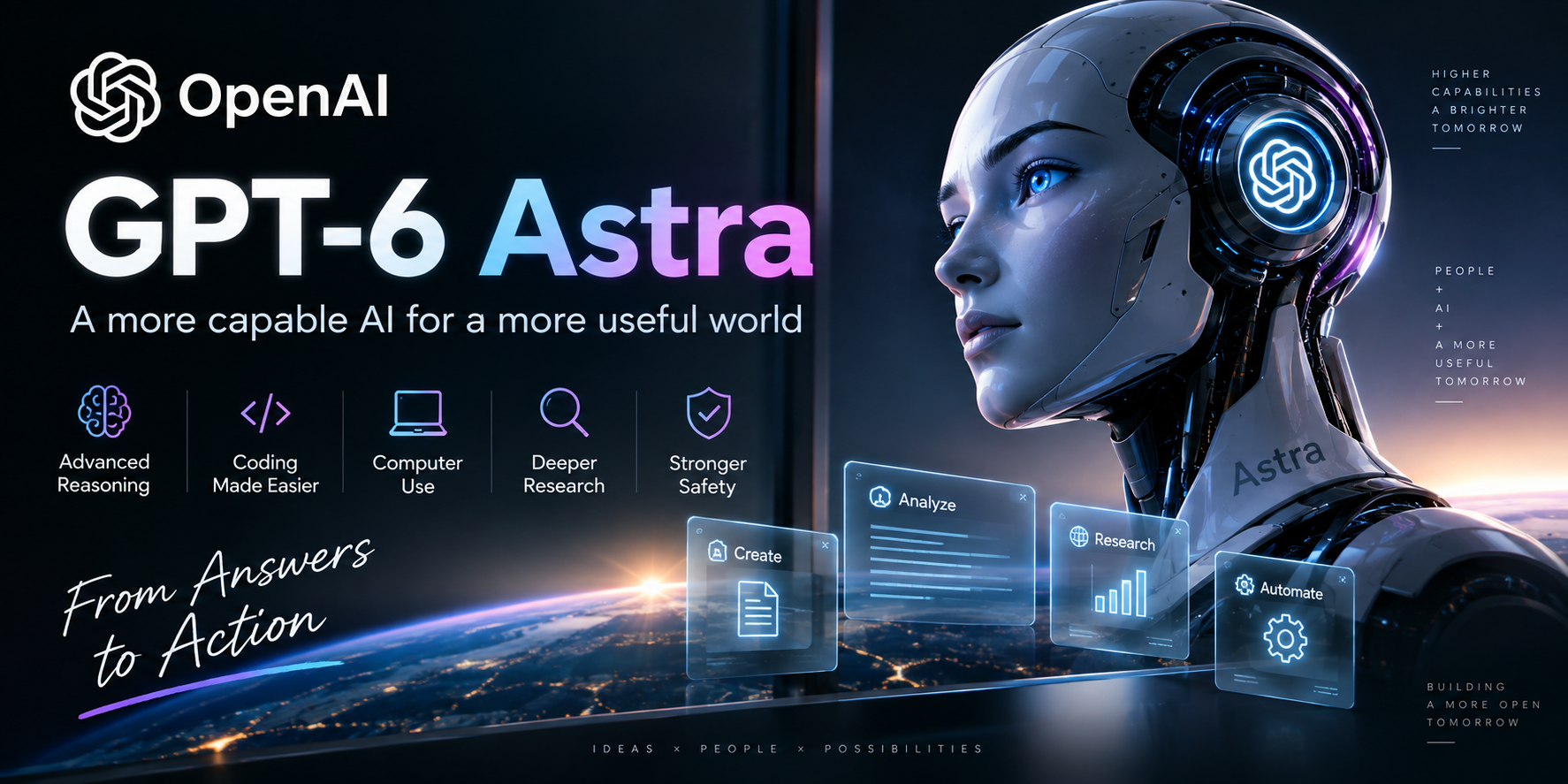
GPT-6 Astra: OpenAI's New Model Is Built to Actually Get Things Done
OpenAI has introduced GPT-6 Astra, its newest flagship model, and this release feels a little different from the usual “new model is smarter” announcement.
The interesting part isn't just better answers. Astra is designed to handle much larger, more complicated jobs that involve reasoning, coding, research, computer use, and creating finished work.
In simple terms, OpenAI is pushing GPT further away from being just a chatbot and closer to being an AI that can actually work on a task with you.
So, what exactly is GPT-6 Astra?
GPT-6 Astra is OpenAI's most capable model for complex, end-to-end work. It is aimed at tasks that can involve several steps rather than a single question and answer.
According to OpenAI, Astra is particularly strong in computer use, browsing, software engineering, science, research, cybersecurity, and professional work.
That distinction is important.
For example, instead of asking an AI how to organize information in a spreadsheet and then doing the work yourself, an agentic model can potentially work directly with the computer environment and carry out parts of that process.
That's where Astra starts becoming more interesting.
The biggest upgrade: computer use
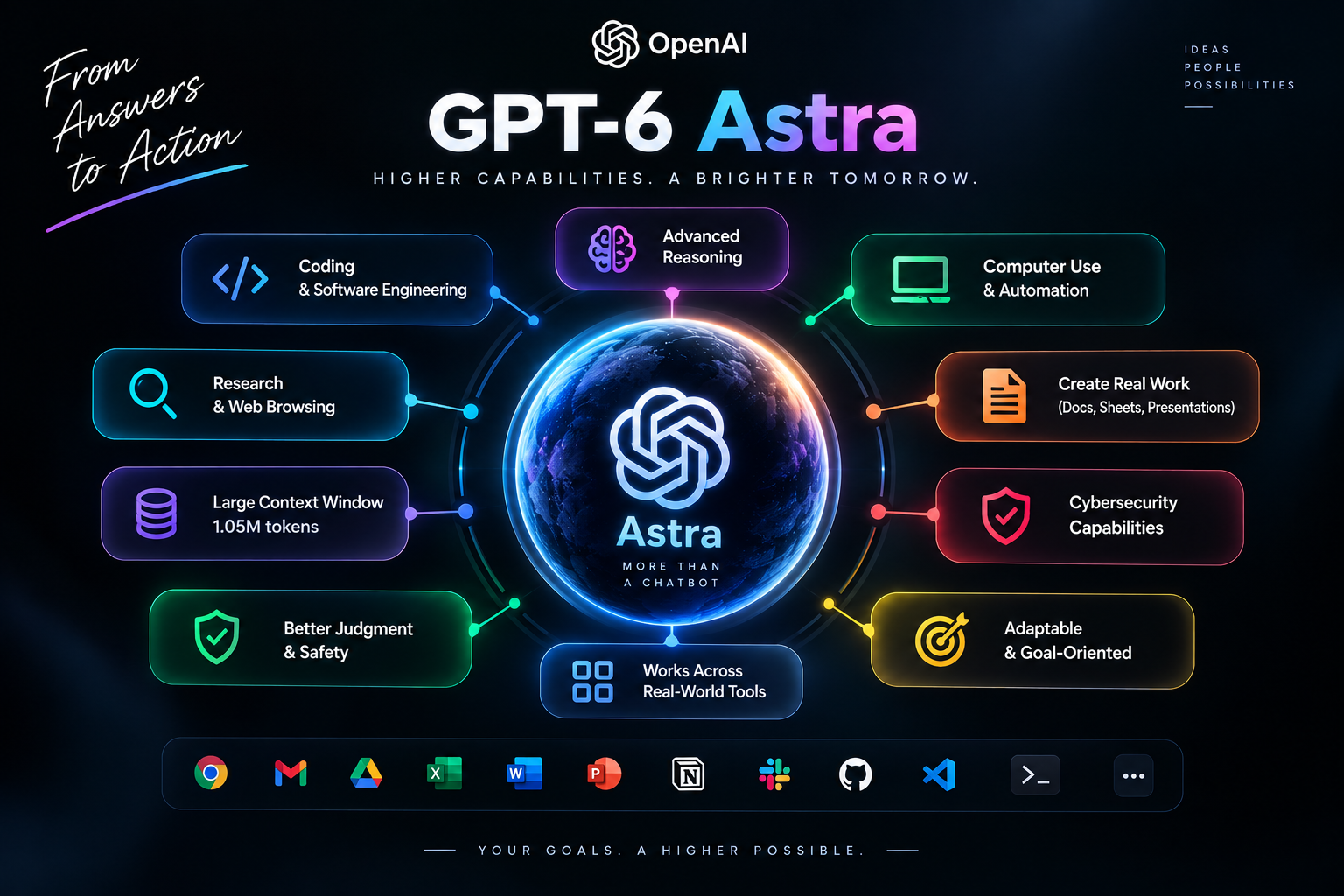
One of Astra's most noticeable capabilities is its ability to interact with computers.
OpenAI says Astra can handle tasks such as filling out online forms, updating CRM records, organizing calendars, researching information online, working with documents, testing software, and troubleshooting problems on screen.
This changes the relationship between the user and AI.
A normal chatbot mostly gives you information.
An AI agent can take that information and use available tools to move the task forward.
Of course, that doesn't mean you should blindly hand over everything to an AI. But for repetitive computer work, the potential is pretty obvious.
Astra is also built for serious coding
Developers are another major target for Astra.
OpenAI describes it as its strongest model for software engineering so far. It can work through complicated coding tasks, understand larger projects, use development tools, and handle multi-step engineering workflows.
The difference is less about generating a random code snippet and more about staying with a project.
A real software task might involve reading an existing codebase, finding a bug, changing several files, testing the result, noticing another problem, and then fixing that too.
That's the kind of workflow where a stronger reasoning model can make a real difference.
It can create documents, spreadsheets and presentations
Astra isn't limited to code.
OpenAI says the model can create documents, spreadsheets, presentations, and analyses while following existing templates and instructions. It can also adapt when requirements change during the task.
This is something that sounds small until you actually use it.
Most real work isn't completed in one prompt.
You might start with a report, realize that the audience is different, add another data source, change the structure, and then ask for a shorter version.
A model that can keep track of the larger objective while adapting to those changes is much more useful than one that simply produces a nice-looking first draft.
A huge context window
For developers, Astra comes with a 1.05 million-token context window and supports up to 128,000 output tokens.
That gives developers considerably more room to work with large codebases, research material, documentation, and other long-running tasks.
Large context alone doesn't automatically make a model better, but it becomes especially useful when combined with reasoning and tool use.
Astra is not just about being smarter
There's another part of the announcement that deserves attention: judgment.
OpenAI says Astra has been trained to better understand user intent and stay within the boundaries of a task. When an instruction is ambiguous, it can make routine assumptions, but it is also designed to ask when a decision could materially change the result.
That matters more as AI becomes capable of taking actions.
If a chatbot misunderstands a question, you can simply correct it.
If an AI agent misunderstands a task and starts changing files, sending information, or interacting with external systems, the consequences can be much bigger.
So better judgment isn't just a nice feature. It's becoming necessary.
And then there is cybersecurity
Astra's capabilities also come with a more serious side.
OpenAI says GPT-6 Astra is its first model to reach the Critical level of cybersecurity capability under its Preparedness Framework. The company says the model can, with the right tools and access, discover previously unknown security vulnerabilities and develop exploits across well-protected systems.
That is a major capability, but also a major responsibility.
As AI becomes better at cybersecurity, the same technology can potentially help defenders find vulnerabilities faster while also creating new risks if misused. OpenAI says it strengthened safeguards and monitoring before releasing Astra.
Does this mean AGI?
Not necessarily.
It is tempting to look at a model that can reason, code, browse the internet, operate a computer, and work through complicated professional tasks and immediately call it AGI.
But those are different things.
Astra represents a significant step toward more capable and more autonomous AI systems, but OpenAI's announcement does not declare that GPT-6 Astra is AGI.
The more interesting question is probably what happens next.
If models continue becoming better at reasoning while also gaining access to computers, software, tools, and persistent workflows, the definition of an “AI assistant” could change considerably.
When will people be able to use GPT-6 Astra?
Astra began rolling out to a limited group of organizations, with broader availability planned for ChatGPT Plus, Pro, Business, and Enterprise users as well as through the OpenAI API, Microsoft Azure, and AWS Bedrock.
Availability can depend on the specific product and account, so seeing Astra immediately may not be guaranteed for everyone during the rollout.
The bigger picture
The most interesting thing about GPT-6 Astra isn't a benchmark number.
It's the direction OpenAI is taking.
For years, the basic interaction with AI was simple: ask → receive answer → do the work yourself.
Astra pushes toward something closer to:
give the AI a goal → let it reason → let it use tools → review the result.
That is a meaningful shift.
It doesn't mean humans suddenly become unnecessary, and it certainly doesn't mean every task can be handed over safely. But it does suggest that the next generation of AI products will increasingly compete on what they can actually accomplish, not just how impressive their answers sound.
And honestly, that's probably the more interesting future.
Frequently Asked Questions
What is GPT-6 Astra?
GPT-6 Astra is OpenAI's newest flagship model, designed for complex reasoning, coding, research, computer use, and multi-step professional workflows.
What is the biggest feature of GPT-6 Astra?
One of its biggest improvements is computer use. Astra can interact with software and websites to perform multi-step tasks rather than simply explaining how a person should do them.
Is GPT-6 Astra better than GPT-5.6?
For complex reasoning, coding, computer use, and agentic workflows, OpenAI positions Astra as its more capable flagship model. It is also designed to handle demanding end-to-end tasks that require multiple steps.
How large is Astra's context window?
GPT-6 Astra supports a context window of 1.05 million tokens and a maximum output of 128,000 tokens through the API.
Can GPT-6 Astra code?
Yes. Software engineering is one of Astra's major use cases. It is designed for complex coding and multi-step development workflows, rather than only generating individual snippets.
Can Astra use a computer?
Yes. Astra can interact with computer interfaces and perform tasks such as navigating websites, filling forms, working with applications, testing software, and researching information.
Is GPT-6 Astra AGI?
No official announcement says that Astra is AGI. It is a significantly more capable and agentic AI model, but AGI is a broader concept than simply having strong performance across many tasks.
Is GPT-6 Astra safe?
OpenAI has introduced additional safeguards and monitoring around Astra. The model also represents a significant increase in cybersecurity capability, which is why safety and misuse prevention are particularly important for this release.
Who can use GPT-6 Astra?
Astra is rolling out through ChatGPT and the OpenAI API, with availability expanding to Plus, Pro, Business, and Enterprise users. It is also being made available through platforms including Microsoft Azure and AWS Bedrock.
What makes Astra different from a normal chatbot?
The simplest way to describe the difference is this: a chatbot primarily answers, while an agentic model can increasingly work toward completing a goal by reasoning through multiple steps and using tools.
That shift—from answering questions to actually doing work—is what makes GPT-6 Astra one of the more interesting AI releases to watch.
Written by
Jayesh Gavit
IT Engineer & Content Creator, JGblogs
IT engineer with a passion for technology and building things. Started JGblogs in 2026 to share information and make government schemes, jobs, and career guides accessible to every Indian — free, in their own language.
About the author →Article