India's graduate unemployment crisis 2026 — what the data says
Azim Premji University's State of Working India 2026 report reveals 40% graduate unemployment under age 25. Full data, causes, and what to do about it.
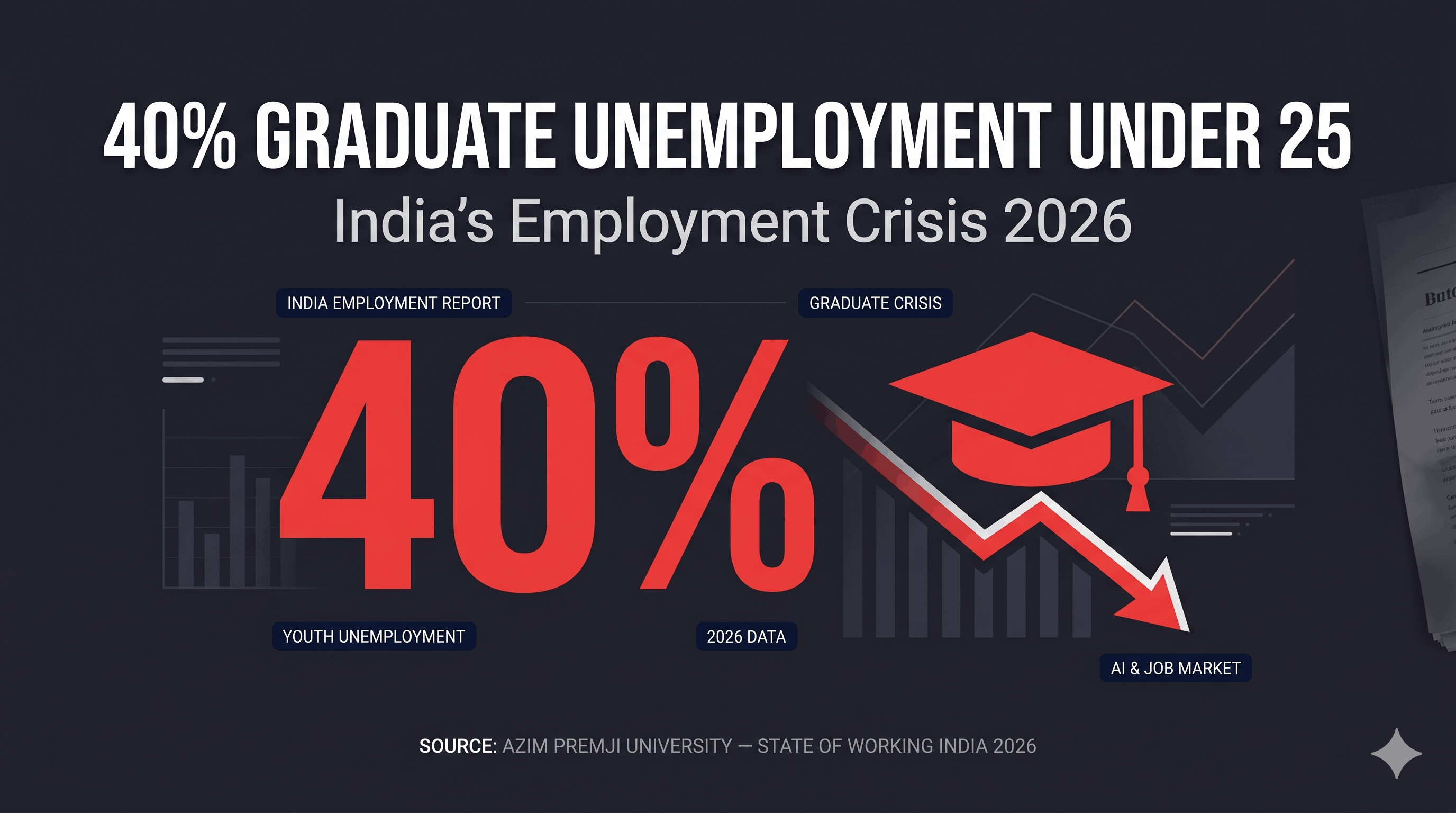
A degree in hand and no job to show for it. For millions of young Indians, this is not just personal frustration — it is a data point in a national crisis. The State of Working India 2026 report by Azim Premji University, published in March 2026, lays out the numbers clearly: nearly 40% of graduates aged 15 to 25 are unemployed. This article breaks down what the report actually says, why the problem persists, and what it means for you if you are a student or recent graduate in India today.
Data source: All figures in this article are from the State of Working India 2026 report published by Azim Premji University's Centre for Sustainable Employment, March 2026.
What the report found — the core data
The State of Working India 2026 report is not a single survey. It is a longitudinal analysis of 40 years of employment trends using Periodic Labour Force Survey (PLFS) microdata — one of the most rigorous employment studies published in India.
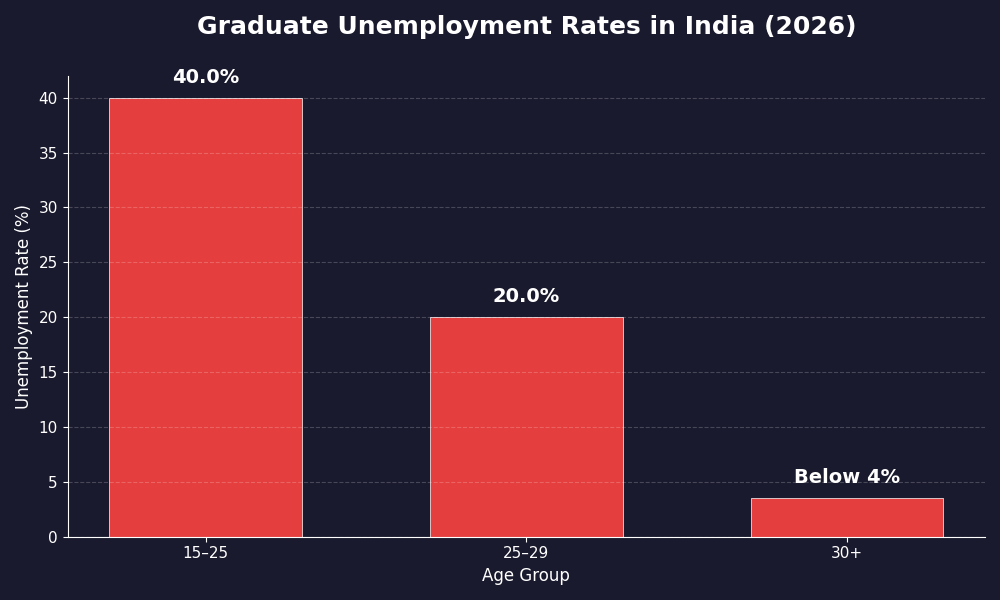
Unemployment by age group
Ages 15–25: graduate unemployment at nearly 40%
Ages 25–29: graduate unemployment at around 20%
Ages 30 and above: below 4% — but not because good jobs were found
The data makes one thing clear: the years immediately after graduation are the hardest. The drop after age 30 is largely explained by graduates settling into informal or low-wage work — not by finding stable salaried employment.
The numbers in scale
India's youth population aged 15–29: 36.7 crore — one third of the working-age population
Total graduates aged 20–29: 6.3 crore
Among them, unemployed: 1.1 crore (2023 data)
The most alarming data point
Of all unemployed graduates who report themselves as jobless, only 7% secure a permanent salaried job within one year. The remaining 93% end up in informal work, gig roles, or remain searching.
This graduate unemployment rate has been stuck at 35–40% for the past four decades. College enrolment has grown. The number of graduates has risen sharply. The employment picture has barely moved.
It is not just unemployment — the quality of jobs matters too
The unemployment rate alone does not tell the full story. The nature of jobs being found is equally concerning.
50% of young male graduates find some form of work within a year of reporting unemployment — but only 7% of those secure permanent salaried positions
The rest move into informal work, short-term contracts, or self-employment
Entry-level salaries for young male graduates have grown slowly since 2011
The gender earnings gap has narrowed — but female graduates still earn significantly less in absolute terms
AI's impact on IT hiring — freshers hit hardest
The graduate unemployment problem has been made sharper by AI's disruption of the IT sector — historically the largest employer of engineering graduates in India.
India's four largest IT companies — TCS, Infosys, Wipro, and HCL — cut fresh graduate hiring by 70% between FY2023 and FY2024, dropping from 2,25,000 annual hires to just 60,000.
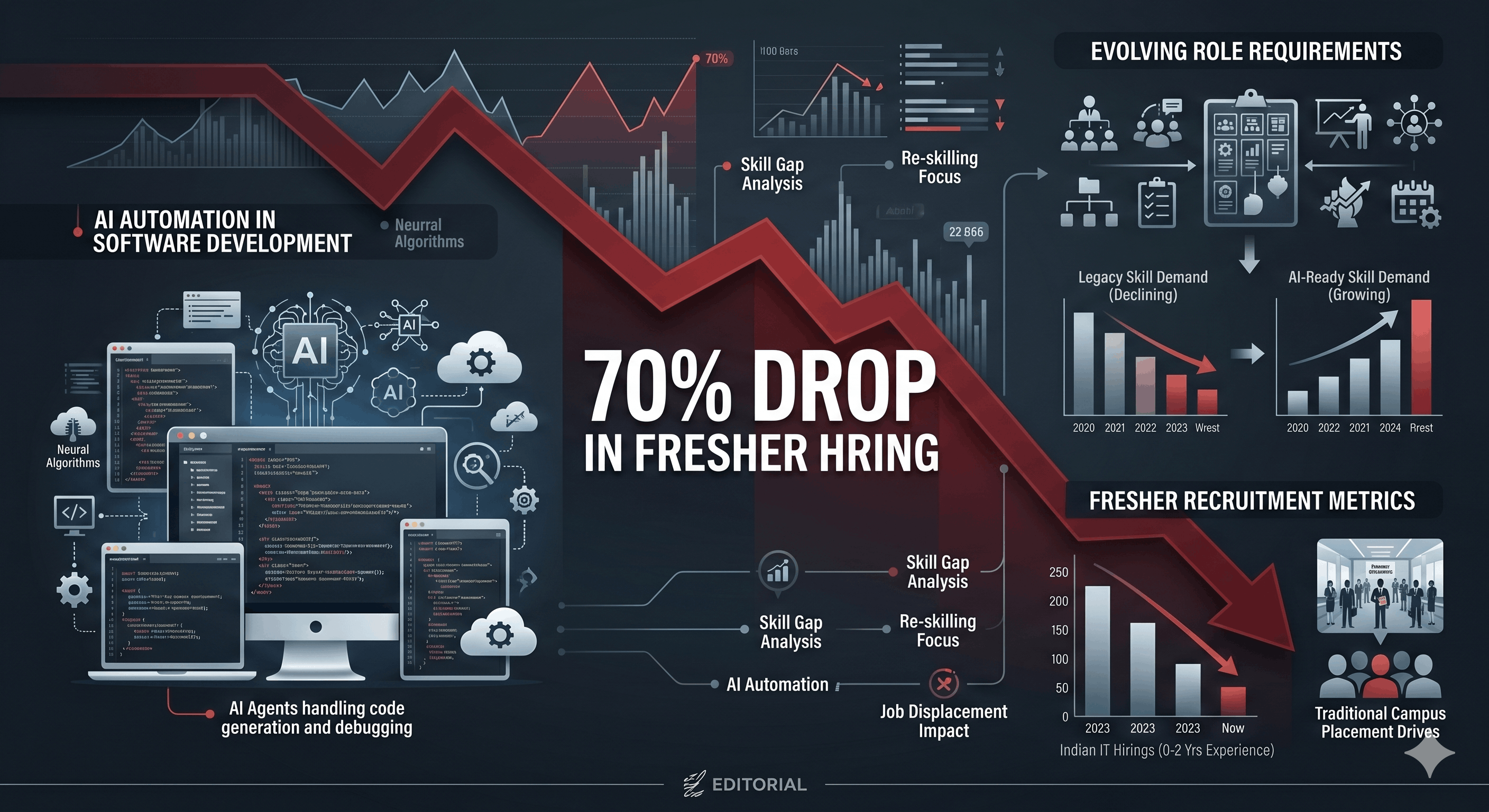
Why this happened:
AI tools have automated entry-level tasks — coding assistance, data entry, basic software testing — that previously served as training ground for freshers
Companies now prefer experienced, AI-skilled professionals over volume hiring of fresh graduates
TCS and Infosys together shed a combined 38,000 employees in FY2024
The arithmetic is stark: India adds 80–90 lakh people to its workforce every year. The IT sector projects only 50,000 net new jobs per year through FY2026–28.
Does a degree still matter?
The report does not say degrees are worthless — but it is clear that a degree alone is no longer enough.
According to the report, graduates earn roughly twice as much as non-graduates at entry level, and this earnings gap widens over a career. The premium is real — but only materialises if you get the job in the first place.
A separate report — India's Graduate Skill Index 2025 by Mercer-Mettl — found that only 42.6% of Indian graduates are employable in the eyes of employers, down from 44.3% in 2023. More than half of graduates do not have the skills employers are actively looking for.
Why this problem persists — 3 root causes
1. The curriculum gap
Most colleges still teach syllabi designed 10–15 years ago. AI, Data Analytics, Cloud Computing, and Cybersecurity are in high demand — but are rarely taught with depth in standard engineering or arts programmes.
2. Soft skills are not being built
Technical skills matter, but employers consistently cite communication, problem-solving, and teamwork as the deciding factors in hiring decisions. Most colleges offer no structured training in these areas.
3. Graduates start searching after graduation
Many students begin job hunting only after receiving their degree. By the time they are interview-ready — resume built, skills practised, networks made — 6 to 12 months have already passed.
What you can do — 5 practical steps
This data is alarming — but it carries a clear message: skills and portfolio matter more than the degree itself.
Start building skills during graduation — pick one skill (Data Analytics, Web Development, Cloud, Digital Marketing) and commit to it before you graduate
Build a visible portfolio — publish projects on GitHub, Kaggle, or Medium; update your LinkedIn with real work
Use free government courses — SWAYAM (IIT and IIM courses), PMKVY, and Skill India Digital Hub offer free training and certificates
Get an internship early — complete at least one internship before your final year
Apply before you feel ready — waiting for the perfect resume costs months; apply and improve in parallel
The State of Working India 2026 report is a structural warning, not a personal verdict. The 40% unemployment figure has persisted for four decades not because Indian graduates are unambitious — but because the education-to-employment pipeline is broken. You cannot fix the system alone. But you can position yourself in the 7% who secure stable employment within a year of graduation — by building skills, gaining experience early, and making your work visible before you even finish your degree.
Frequently asked questions
Does this data apply to engineering graduates specifically?
The report covers all graduates, not engineering alone. However, IT sector data tells a specific story for engineering freshers: entry-level hiring dropped 70% in two years. The graduates finding good IT jobs in 2026 are those with AI, Data Science, and Cloud skills — not general CS degrees alone.
Is the government addressing this problem?
PMKVY 4.0, Skill India Digital Hub, and SWAYAM were all designed to address exactly this gap. However, these programs require you to actively seek them out — they do not automatically reach students. Using them is entirely your responsibility and choice.
Is it harder for graduates from smaller cities?
The report specifically notes that Karnataka, Tamil Nadu, Kerala, and Andhra Pradesh perform well in higher education access but face growing challenges in skill training and graduate employment. For Tier-2 and Tier-3 city graduates, online skills carry even more weight because local job markets are more limited and remote or hybrid roles require demonstrated, verifiable skills.
Written by
Jayesh Gavit
IT Engineer & Content Creator, JGblogs
IT engineer with a passion for technology and building things. Started JGblogs in 2026 to share information and make government schemes, jobs, and career guides accessible to every Indian — free, in their own language.
About the author →Article