Best courses after 12th commerce in 2026 — from CA to Digital Marketing
Best courses after 12th commerce 2026 — CA, BBA, B.Com, CS, LLB, Digital Marketing. Salary, eligibility and career scope for every type of commerce student.
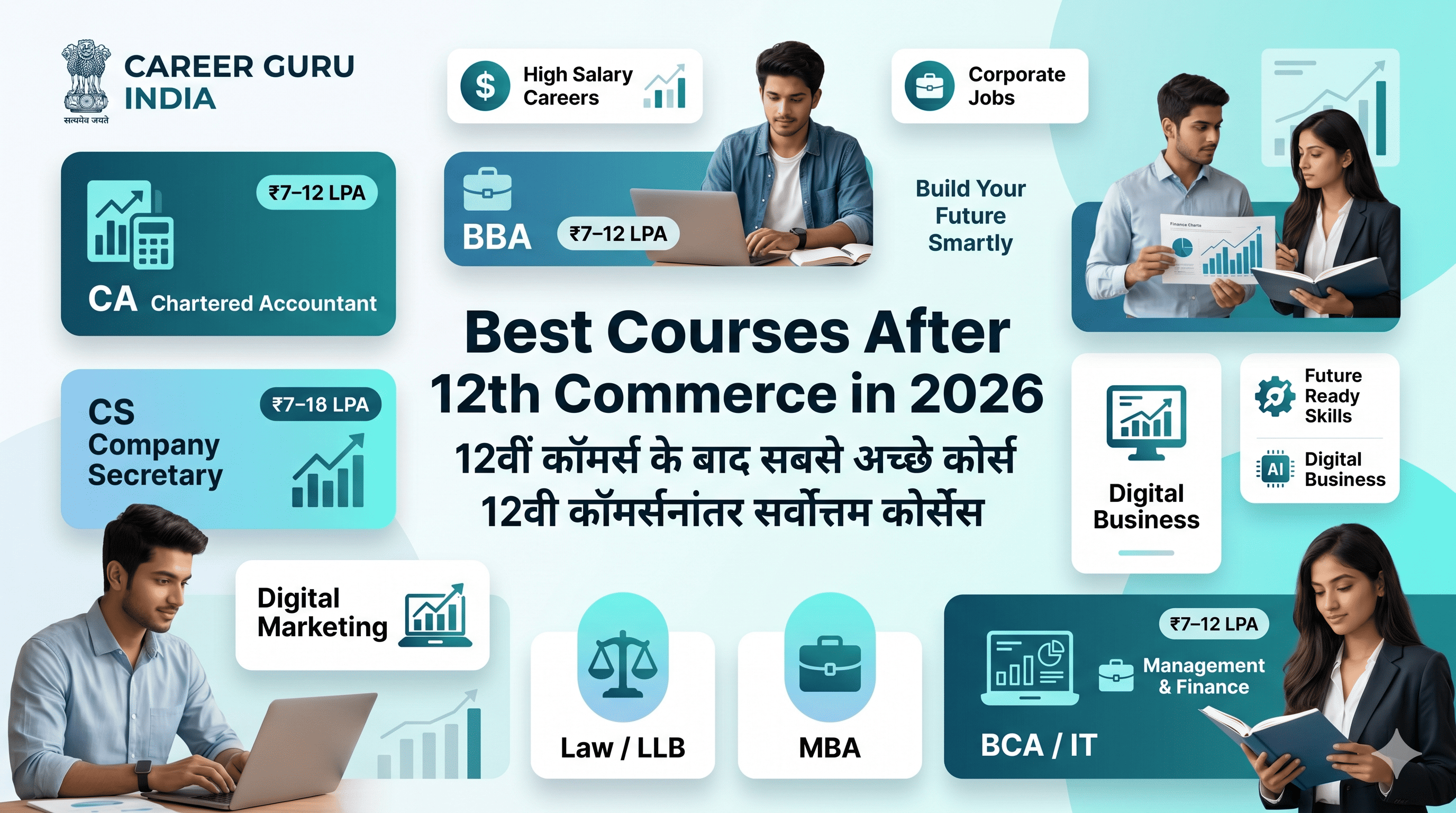
Commerce students in 2026 have more options than any previous generation. The stream now reaches into finance, law, management, technology, and digital business — not just accounting. This guide covers the best courses after 12th commerce with honest salary data, who each course is best for, and what the career actually looks like.
Salary note: All salary figures are sourced from LinkedIn India, AmbitionBox, and industry reports 2026.
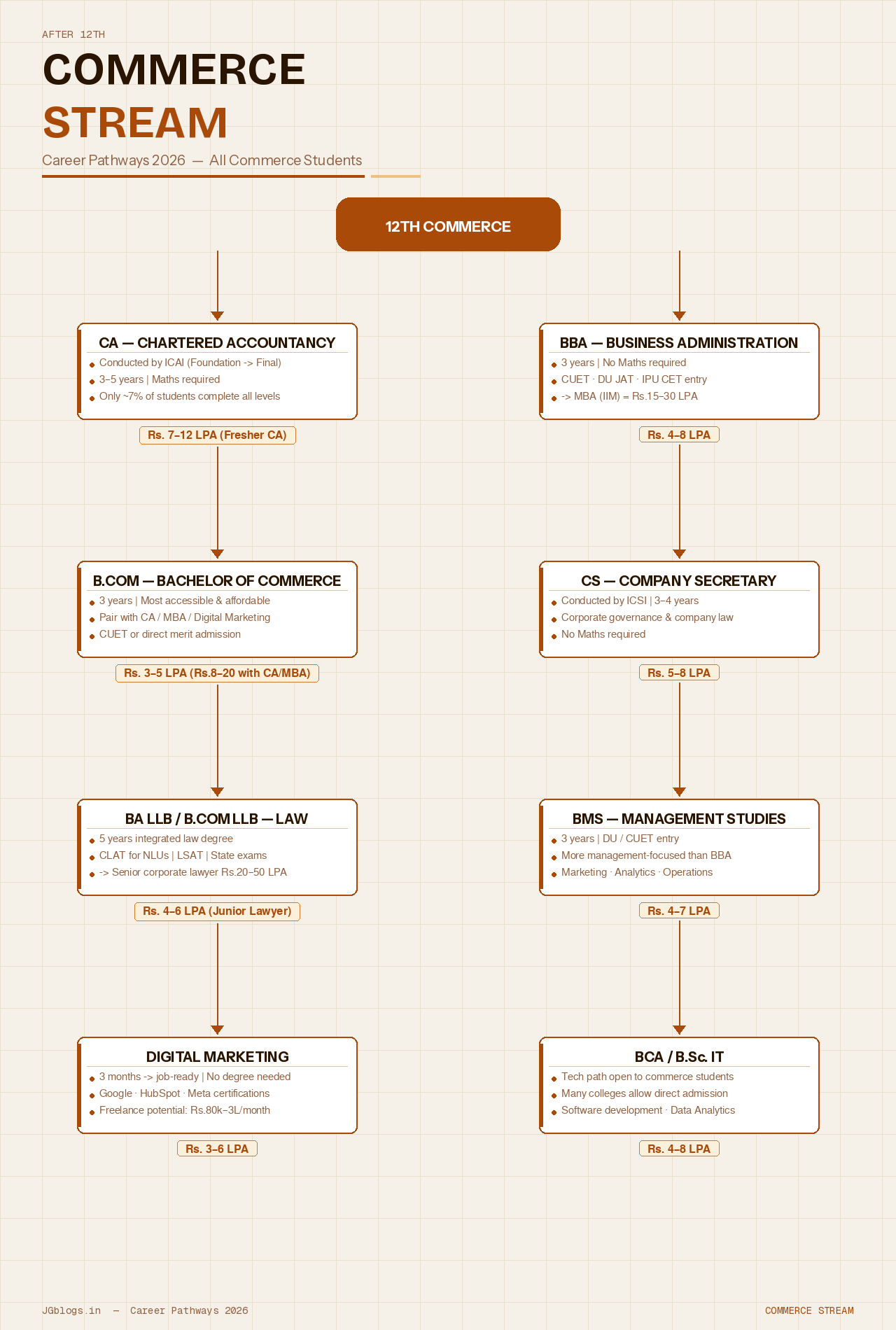
1. Chartered Accountancy (CA)
Conducted by: ICAI (Institute of Chartered Accountants of India)
Duration: 3–5 years — Foundation → Intermediate → Final
Eligibility: Start after 12th with CA Foundation level
Starting salary (fresh CA): ₹7–12 LPA
Senior CA salary: ₹25–50+ LPA
Completion rate: Only about 7% of students who start CA complete all three levels
CA is the highest-ceiling professional course for commerce students in India. It covers taxation, auditing, accounting, and corporate law. The qualification is highly respected and opens doors in Big 4 firms, corporate finance teams, and independent practice.
Honest perspective: CA is India's most difficult professional exam. Choose it because you genuinely enjoy numbers and analytical work — not because of social pressure or parental expectation.
2. BBA (Bachelor of Business Administration)
Duration: 3 years
Admission: CUET, DU JAT, IPU CET, or direct merit
Starting salary: ₹4–8 LPA
Career path: BBA → MBA (IIM or top B-school) = ₹15–30+ LPA
Scope: Marketing, Sales, HR, Operations, Finance, Consulting
BBA is the most flexible commerce course — it does not require Maths and is also open to Arts students. Combined with an MBA from a top institute, it builds one of the strongest corporate career paths available after 12th.
3. B.Com (Bachelor of Commerce)
Duration: 3 years
Admission: CUET or direct merit
Starting salary: ₹3–5 LPA with B.Com alone
With CA, CMA, or MBA: ₹8–20 LPA
Specialisations: B.Com Honours, B.Com Accounting, B.Com Banking and Insurance
B.Com is the most widely available and affordable commerce degree in India. However, the degree alone rarely leads to high salaries. Pairing B.Com with a professional qualification — CA, CMA, or MBA — or building a skill set in Digital Marketing or Data Analytics is what moves the salary needle.
4. Company Secretary (CS)
Conducted by: ICSI
Duration: 3–4 years — Foundation → Executive → Professional
Starting salary: ₹5–8 LPA
Senior CS salary: ₹15–25 LPA
Scope: Corporate governance, legal compliance, company law, secretarial practice
CS suits students who are more interested in law and corporate compliance than in the number-heavy work of CA. The qualification is structured, has a higher completion rate than CA, and leads directly into compliance and legal advisory roles.
5. BA LLB / B.Com LLB (Integrated Law)
Duration: 5 years integrated | 3 years LLB after graduation
Entrance exam: CLAT (for National Law Universities), LSAT, State law entrance exams
Starting salary: ₹4–6 LPA (junior lawyer) | ₹20–50 LPA (senior corporate lawyer)
Scope: Litigation, corporate law, legal consulting, judicial services
Law is a long-term, high-earning career that rewards patience and consistency. Graduates from NLUs receive fresher packages of ₹12–20 LPA at top law firms.
6. BMS (Bachelor of Management Studies)
Duration: 3 years
Admission: DU entrance, CUET
Starting salary: ₹4–7 LPA
Scope: Management, analytics, marketing — slightly more management-focused than BBA
7. Digital Marketing
Duration: 3 months to 1 year (certificate) | 3 years (B.Voc)
Starting salary: ₹3–6 LPA at agencies | ₹5–8 LPA in-house
Freelancing potential: ₹80,000–₹3 lakh per month
Free certifications: Google Digital Garage, HubSpot Academy, Meta Blueprint
The fastest route to income for commerce students. You can be job-ready in 2–3 months without spending on a full degree.
8. BCA / B.Sc. IT (for tech-interested commerce students)
Many colleges accept commerce students directly into BCA and B.Sc. IT programmes. This opens a complete technology career path — software development, data analytics, and IT roles — without requiring a science stream background.
Quick comparison
Course | Duration | Starting salary | Maths required? |
|---|---|---|---|
CA | 3–5 years | ₹7–12 LPA | Yes |
BBA | 3 years | ₹4–8 LPA | No |
3 years | ₹3–5 LPA | No | |
CS | 3–4 years | ₹5–8 LPA | No |
BA LLB | 5 years | ₹4–6 LPA | No |
Digital Marketing | 3 months+ | ₹3–6 LPA | No |
Commerce in 2026 is one of India's most versatile academic streams. For high salary choose CA. For quick income choose Digital Marketing. For long-term corporate growth choose BBA followed by MBA. For law and compliance choose CS or LLB. Pick the path that matches your genuine interest and commit to it fully.
Frequently asked questions
Should I choose CA or BBA?
Choose CA if you genuinely enjoy numbers, taxation, and audit work — it offers the highest long-term salary ceiling. Choose BBA if you are interested in business, management, and people — follow it with an MBA for the best career outcome. Both are strong paths; the right choice depends entirely on your personal interest, not on which sounds more impressive.
What are the best options in commerce without Maths?
BBA, B.Com, CS, LLB, Digital Marketing, Event Management, and Mass Communication do not require Maths. Only CA, B.Sc. Economics, and Actuarial Science benefit significantly from a strong Maths background.
Can commerce students build a technology career?
Yes. Many colleges accept commerce students into BCA and B.Sc. IT programmes. Additionally, Data Analytics (with SQL, Excel, and Power BI), Digital Marketing, and Product Management are fields where commerce background students perform very well alongside tech graduates.
Written by
Jayesh Gavit
IT Engineer & Content Creator, JGblogs
IT engineer with a passion for technology and building things. Started JGblogs in 2026 to share information and make government schemes, jobs, and career guides accessible to every Indian — free, in their own language.
About the author →Article
Related articles
How to Get Your First Cybersecurity Job in 2026: Complete Beginner Roadmap
7 June 2026·1,250 views
Jobs That May Grow Fast in India by 2030: Top Careers, Skills, Salary & Future Trends
24 May 2026·1,250 views