Best courses after 12th science in 2026 — complete guide for PCM and PCB students
Best courses after 12th science 2026 — B.Tech, MBBS, Data Science, Pharmacy, Nursing. Salary, eligibility and career scope for PCM and PCB students.
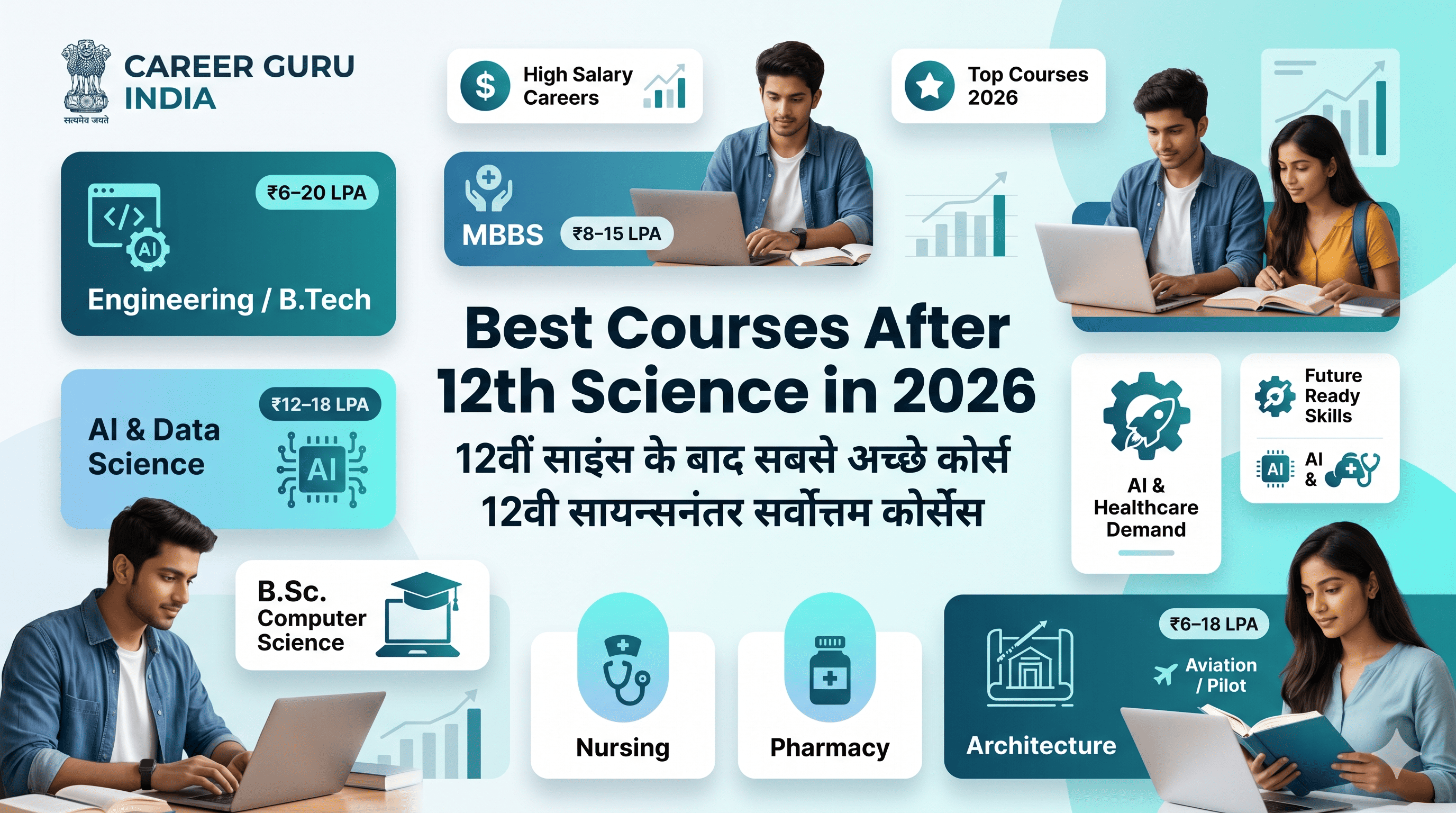
Finishing 12th science with good marks is one thing — knowing what to do next is another. The choice between engineering and medicine, between a 3-year B.Sc. and a 5-year professional degree, between a government college and a private one, shapes your next decade. This guide covers the best courses available in 2026 for science stream students across both PCM and PCB groups — with honest salary data, entrance exam requirements, and what each career actually looks like.
Salary note: All salary figures are based on LinkedIn India, Naukri 2026, and industry reports. Actual salary depends on college, skills, location, and experience.
Best courses for PCM students
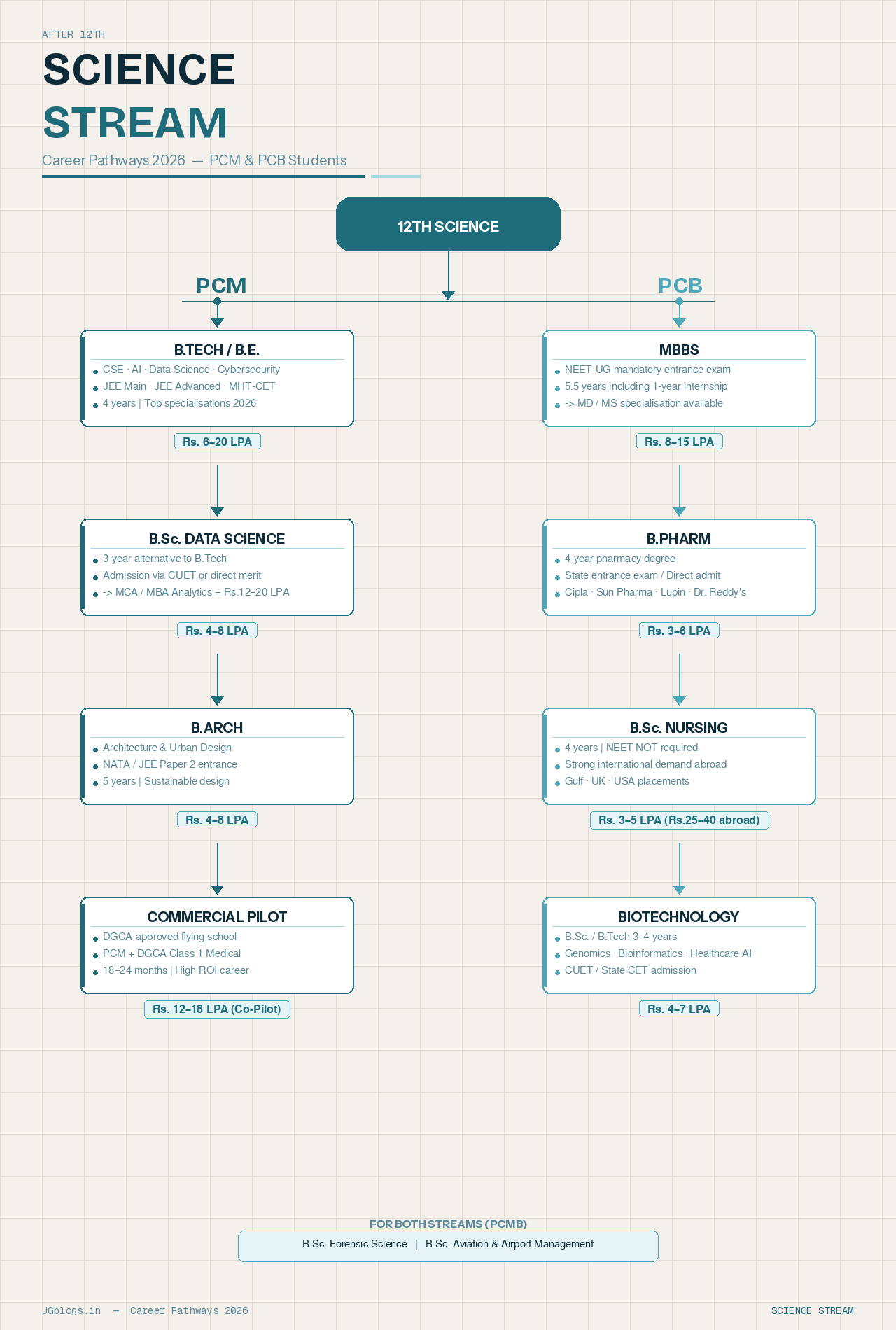
B.Tech — Engineering (CSE, AI, Data Science, Cybersecurity)
Duration: 4 years
Entrance exam: JEE Main, JEE Advanced, MHT-CET (Maharashtra)
Starting salary: ₹6–20 LPA depending on college and specialisation
Top specialisations: Computer Science, Artificial Intelligence, Data Science, Cybersecurity, Robotics
In 2026, B.Tech graduates in AI and Data Science earn 40% more than general engineering graduates at the entry level. Top product companies and IIT campus placements offer packages ranging from ₹20 LPA to ₹54 LPA. The key difference in 2026 is specialisation — a generic CS degree from a tier-3 college has far lower return than a focused AI or Cybersecurity degree from a well-ranked institute.
B.Sc. Data Science / B.Sc. Computer Science
Duration: 3 years
Admission: CUET or direct merit
Starting salary: ₹4–8 LPA
Career path: BCA or B.Sc. → MCA or MBA in Analytics → ₹12–20 LPA roles
A smart alternative for students who missed JEE ranks but want a tech career at lower cost and shorter duration.
Architecture (B.Arch)
Duration: 5 years
Entrance exam: NATA, JEE Paper 2
Starting salary: ₹4–8 LPA
Scope: Urban planning, sustainable design, interior architecture, real estate
Commercial Pilot Training
Duration: 18–24 months at a DGCA-approved flying school
Eligibility: 12th PCM + DGCA Class 1 Medical
Starting salary: ₹12–18 LPA as Co-Pilot
Investment: ₹40–60 lakh — high cost but strong long-term ROI
Best courses for PCB students
MBBS
Duration: 5.5 years including 1-year internship
Entrance exam: NEET-UG (mandatory)
Starting salary: ₹8–15 LPA in private sector | lower but stable in government hospitals
Long-term: Post-specialisation (MD/MS) in cardiology, neurology or oncology — ₹30–70 LPA
MBBS remains India's most prestigious medical qualification. Government college fees are significantly lower for merit and reserved category students.
B.Pharm (Pharmacy)
Duration: 4 years
Entrance exam: State pharmacy entrance or direct admission
Starting salary: ₹3–6 LPA
Mid-career in R&D or MNC pharma: ₹15–25 LPA
Top recruiters: Cipla, Sun Pharma, Lupin, Dr. Reddy's Laboratories
India is the world's third-largest pharmaceutical producer by volume — demand for B.Pharm graduates is consistent regardless of economic cycles.
B.Sc. Nursing
Duration: 4 years
Admission: State nursing entrance exam — NEET not required
Starting salary: ₹3–5 LPA (India) | ₹25–40 LPA (Gulf, UK, USA)
Scope: Hospital, ICU, community health, international nursing
International demand for Indian nurses is very strong. BSc Nursing is one of the clearest paths to high international salaries for PCB students.
Biotechnology (B.Sc. / B.Tech)
Duration: 3–4 years
Admission: CUET / State CET
Starting salary: ₹4–7 LPA
Advanced scope: Genomics, bioinformatics, healthcare AI — ₹20 LPA and above
For both streams (PCMB students)
B.Sc. Forensic Science
Duration: 3 years | Starting salary: ₹3–5 LPA (Government) | ₹6–10 LPA (Private labs)
B.Sc. Aviation and Airport Management
Duration: 3 years | Starting salary: ₹4–8 LPA
Quick comparison
Course | Duration | Entrance | Starting salary |
|---|---|---|---|
B.Tech (CSE/AI) | 4 years | JEE/MHT-CET | ₹6–20 LPA |
MBBS | 5.5 years | NEET | ₹8–15 LPA |
B.Pharm | 4 years | State level | ₹3–6 LPA |
B.Sc. Nursing | 4 years | State level | ₹3–5 LPA |
B.Sc. Data Science | 3 years | CUET/Merit | ₹4–8 LPA |
Architecture | 5 years | NATA | ₹4–8 LPA |
Commercial Pilot | 2 years | DGCA | ₹12–18 LPA |
How to choose the right course — 4 honest questions
Do you enjoy technology or biology more? — PCM points toward engineering and tech; PCB toward medicine and life sciences
How many years are you willing to study before your first paycheck? — MBBS is 5.5 years; B.Sc. is 3; be honest about your patience
What is your realistic budget? — MBBS in a government college costs ₹2–5 lakh total; private medical college can cost ₹50–80 lakh
Are you willing to prepare for a competitive entrance exam? — NEET and JEE both require serious, consistent preparation over months
In 2026, science stream students have a clear advantage — AI, Data Science, and Healthcare are all at record demand. The right course aligned with your interest, combined with internships and a real skills portfolio, is what actually leads to a good job.
Frequently asked questions
Can PCB students pursue medical careers without NEET?
Yes. B.Pharm, B.Sc. Nursing, BPT (Physiotherapy), BMLT (Medical Lab Technology), and Radiology Technician are all paramedical courses that do not require NEET and offer strong healthcare careers.
Can PCM students apply for MBBS?
Only if Biology was also a subject in 12th. Students with only Physics, Chemistry, and Maths — without Biology — are not eligible for NEET. Adding Biology as an additional subject in 12th is the only route.
Is B.Tech better than B.Sc. in 2026?
B.Tech generally offers higher starting salaries and stronger industry placement but requires a competitive entrance exam. B.Sc. is more accessible and costs less. If your JEE or MHT-CET rank was not enough for a good college, B.Sc. in Data Science or Computer Science followed by MCA is a smart and increasingly valued alternative.
Written by
Jayesh Gavit
IT Engineer & Content Creator, JGblogs
IT engineer with a passion for technology and building things. Started JGblogs in 2026 to share information and make government schemes, jobs, and career guides accessible to every Indian — free, in their own language.
About the author →Article
Related articles
How to Get Your First Cybersecurity Job in 2026: Complete Beginner Roadmap
7 June 2026·1,250 views
Jobs That May Grow Fast in India by 2030: Top Careers, Skills, Salary & Future Trends
24 May 2026·1,250 views