Top 10 high-paying skills to learn in 2026 for freshers in India
The 10 highest-paying skills for freshers in India in 2026 — with real salary data from Naukri, AmbitionBox, and LinkedIn. No fluff, just facts.
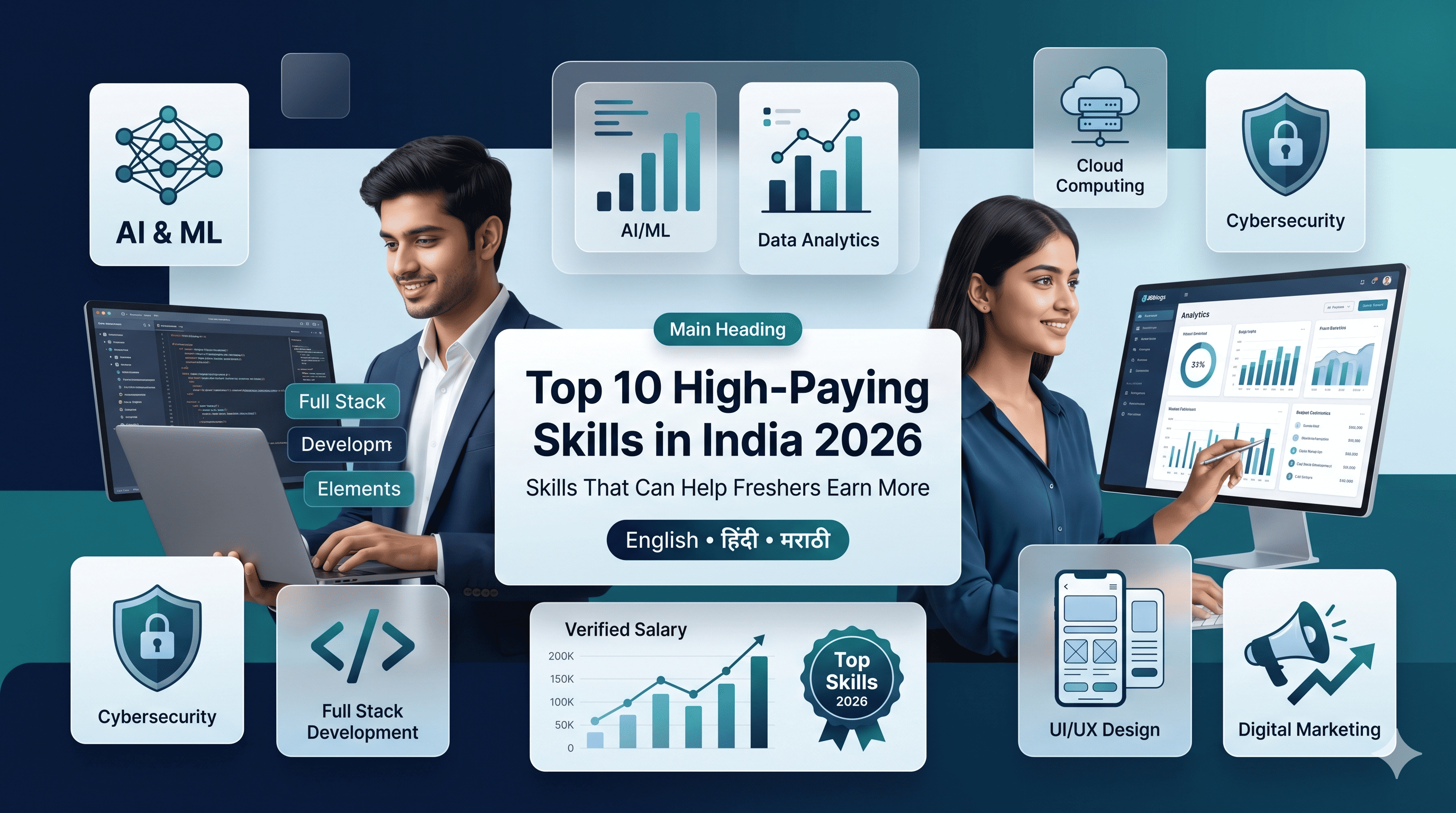
India's job market in 2026 has one clear message: skills matter more than degrees. The Naukri JobSpeak Index recorded a 12% year-on-year rise in white-collar hiring in February 2026, with AI and ML roles alone surging 34%. Companies at every level — from TCS and Infosys to funded startups — are shifting to skills-based hiring. This article lists the 10 highest-paying skills for freshers in India right now, with verified salary figures, what to learn, and exactly where to start.
Salary note: All figures are sourced from AmbitionBox, Naukri, LinkedIn Salary India, and Glassdoor India (April 2026). These are market averages — IIT graduates and top product companies pay significantly more; tier-3 college freshers may start lower.
1. Artificial Intelligence and Machine Learning

Fresher salary: ₹6 – 12 LPA at mid-tier companies | ₹15 – 30 LPA at top product companies and research labs
This is the single highest-paying entry-level field in India in 2026. AI adoption has moved from experimentation to execution across banking, healthcare, manufacturing, and e-commerce — and the demand for engineers who can build and deploy AI models is outpacing supply.
What to learn:
Python (NumPy, Pandas, Scikit-learn)
Machine Learning fundamentals — regression, classification, clustering
Deep Learning — TensorFlow or PyTorch
One real project published on Kaggle or GitHub
Where to learn: Google ML Crash Course (free), Andrew Ng's Machine Learning Specialization on Coursera, NPTEL courses from IITs (free)
Time to entry level: 6–9 months of consistent learning
2. Data Analytics
Fresher salary: ₹3 – 4 LPA with basic skills | ₹6 – 8 LPA with SQL + Python + Power BI + a strong portfolio
Over 100,000 active Data Analyst openings were listed on Naukri as of April 2026. This is the most accessible high-paying skill for non-CS freshers because it does not require software engineering-level programming.
What to learn:
SQL up to window functions — RANK, ROW_NUMBER, LAG/LEAD, CTEs
Microsoft Power BI (PL-300 certification is specifically valued at Indian companies)
Python basics — Pandas and Matplotlib
Google Analytics 4 (free certification via Google Skillshop)
Build a portfolio: Publish 3 data analysis projects on Kaggle or GitHub. This is your resume.
Where to learn: SQLZoo (free), Microsoft Learn (free), Alex the Analyst on YouTube (free)
3. Full Stack Web Development
Fresher salary: ₹5 – 10 LPA
Over 80,000 active full stack developer openings were listed across LinkedIn Jobs India and Naukri in April 2026 — the highest absolute count of any IT role.
Two main paths:
MERN Stack (MongoDB, Express, React, Node.js) — ₹5–9 LPA, dominant at Bangalore startups
Java Full Stack (Spring Boot + React) — ₹5–10 LPA, dominant at enterprise companies like TCS, Infosys, Wipro
What to learn:
HTML, CSS, JavaScript fundamentals
React (frontend framework)
Node.js or Spring Boot (backend)
SQL or MongoDB (database)
Git and GitHub
Who can do this: CS, IT, Electronics, BCA, MCA graduates. Non-CS graduates can access this role with 5–6 months of structured training.
Where to learn: freeCodeCamp (free), The Odin Project (free), Traversy Media on YouTube (free)
4. Cloud Computing (AWS / Azure / GCP)
Fresher salary: ₹5 – 9 LPA with AWS SAA certification | grows to ₹18 – 30 LPA in 3–5 years
Cloud technologies are projected to account for 8% of India's GDP by 2026 and generate 1.4 crore new jobs. Every company is migrating to cloud — and that means every company needs cloud engineers.
Certification roadmap for freshers:
AWS Cloud Practitioner — 4–6 weeks prep, ₹11,000 exam fee — basic credential
AWS Solutions Architect Associate (SAA) — 8–12 weeks prep, ₹20,000 exam fee — gets you interview invitations
Why this works: Cloud certifications are objective and verifiable. HR teams use them as filters. A fresher who passes AWS SAA enters a much smaller candidate pool compared to uncertified applicants.
Where to learn: AWS Skill Builder (free tier), Stephane Maarek's course on Udemy
5. Cybersecurity
Fresher salary: ₹5 – 10 LPA
NASSCOM estimates India needs 1 million cybersecurity professionals by 2026. CERT-In reported over 1.3 million cybersecurity incidents in India in 2023 alone. The talent gap is enormous — trained candidates face far less competition than in most other tech roles.
What to learn:
Network security fundamentals
Ethical hacking and penetration testing basics
Linux command line
Certifications: CompTIA Security+ (entry-level) → CEH (Certified Ethical Hacker)
Practice platforms: TryHackMe and Hack The Box — real-world hacking labs, free to start
Who can do this: CS, IT, ECE graduates — any engineering background
6. UI/UX Design
Fresher salary: ₹4 – 8 LPA
With digital products expanding across every sector, demand for UX and UI designers has increased sharply. Entry-level designers with strong portfolios — not just certifications — get hired at tech companies, fintech firms, SaaS companies, and digital agencies.
What to learn:
Figma — the most in-demand design tool (free to use)
UX Research — user interviews, usability testing, affinity mapping
Wireframing and prototyping
Basic HTML/CSS (helpful but not mandatory)
Portfolio is everything: Build at least 3 case studies — real problem, research process, design solution, outcome. No portfolio = no interview.
Top hiring companies: Swiggy, CRED, Razorpay, Zepto, Meesho, SaaS startups, design agencies
7. Digital Marketing and SEO
Fresher salary: ₹3 – 6 LPA at agencies | ₹5 – 8 LPA at in-house product companies
Every business needs online visibility. Digital marketing is one of the few high-demand skills accessible to freshers from any stream — Science, Commerce, or Arts.
What to learn:
SEO — on-page, off-page, technical
Google Ads and Meta Ads
Google Analytics 4
Content marketing and copywriting
Email marketing basics
Free certifications: Google Digital Garage, HubSpot Academy, Meta Blueprint — all free and recognized by employers
Freelancing ceiling: Skilled digital marketers charge ₹80,000 – ₹3 lakh per month for freelance work
8. DevOps and Automation
Fresher salary: ₹6 – 10 LPA
Companies need faster and more reliable software delivery cycles. DevOps engineers sit between development and operations, automating the build, test, and deploy pipeline.
What to learn:
Linux command line basics
Git and GitHub
Docker and Kubernetes
CI/CD pipelines — Jenkins, GitHub Actions
Cloud basics (AWS or Azure)
Who this is for: CS and IT engineers who want to work on infrastructure alongside software development
9. Product Management (APM route)
Fresher salary: ₹8 – 15 LPA through APM programs
Product Management has become accessible to freshers through structured Associate Product Manager (APM) programs at Swiggy, Flipkart, Meesho, Razorpay, Google, and other companies.
What to learn:
Product thinking and user empathy
Figma basics (for wireframes)
SQL (to pull data independently)
Prioritization frameworks — RICE, MoSCoW
Case study practice — "Design a feature for X" style questions
Engineering advantage: Technical freshers gain credibility faster because engineering teams trust them sooner. The skill gap to close is on business and empathy — not the technical side.
10. Technical Writing
Fresher salary: ₹5 – 10 LPA
Technical writing is consistently underestimated. Every software product needs documentation — API references, user guides, developer docs, release notes. Good technical writers who understand both technology and language are rare and well-paid.
What to learn:
Writing clearly — plain language, structured documents
Markdown and basic HTML
API documentation basics — tools like Postman, Swagger
Docs-as-code workflow — Git, GitHub
Build a portfolio: Write documentation for any open-source project on GitHub, or create sample API docs for a public API like the OpenWeather API.
Quick comparison — all 10 skills at a glance
Skill | Fresher salary (avg) | Time to learn | Best for |
|---|---|---|---|
AI / ML | ₹6 – 12 LPA | 6–9 months | CS, IT, Math |
Data Analytics | ₹6 – 8 LPA | 3–4 months | All streams |
Full Stack Dev | ₹5 – 10 LPA | 5–6 months | CS, IT, BCA |
Cloud Computing | ₹5 – 9 LPA | 2–3 months (cert) | All engineering |
Cybersecurity | ₹5 – 10 LPA | 4–6 months | CS, IT, ECE |
UI/UX Design | ₹4 – 8 LPA | 3–4 months | All streams |
Digital Marketing | ₹3 – 6 LPA | 2–3 months | All streams |
DevOps | ₹6 – 10 LPA | 5–6 months | CS, IT |
Product Management | ₹8 – 15 LPA | 4–6 months | All engineering |
Technical Writing | ₹5 – 10 LPA | 2–3 months | CS, IT preferred |
How to start — 6 steps
Match the skill to your background — check the "best for" column above before picking
Pick one and commit — doing five at once means finishing none
Start with free resources — YouTube, Google Skillshop, NPTEL, freeCodeCamp cover 80% of what you need
Build a real project — no project means no portfolio, and no portfolio means no interview
Set up your LinkedIn profile — add skills, certifications, and project links
Apply before you feel ready — Naukri, LinkedIn, Internshala, Unstop, HackerEarth
The 2026 job market rewards people who build things over people who have marks. One skill, one project, three months — that is your starting point.
Frequently asked questions
Which skill from this list is easiest to start with no prior experience?
Digital Marketing and Data Analytics are the most beginner-friendly. You can reach a job-ready level in 2–3 months using only free resources. No prior technical knowledge is required for Digital Marketing. For Data Analytics, basic Excel comfort is enough to start.
Can a non-engineering fresher get into any of these high-paying roles?
Yes. Digital Marketing, UI/UX Design, Content Writing, and Data Analytics are open to freshers from any stream. Product Management via APM programs also accepts non-engineering graduates with strong case study preparation. AI/ML and DevOps are harder without an engineering foundation.
Should a fresher join a product-based company or a service company?
If you have the option, a product-based company or funded startup will give you faster skill growth, a stronger portfolio, and higher pay. Service companies offer stability and structured onboarding, which suits freshers who want to learn systematically before taking on independent ownership.
Written by
Jayesh Gavit
IT Engineer & Content Creator, JGblogs
IT engineer with a passion for technology and building things. Started JGblogs in 2026 to share information and make government schemes, jobs, and career guides accessible to every Indian — free, in their own language.
About the author →Article
Related articles
How to Get Your First Cybersecurity Job in 2026: Complete Beginner Roadmap
7 June 2026·1,250 views
Jobs That May Grow Fast in India by 2030: Top Careers, Skills, Salary & Future Trends
24 May 2026·1,250 views