Transitioning from College to a Product Role: A Roadmap for Engineers
Bridge the gap from IT student to Product Developer. Learn how to master full-stack skills, build Micro-SaaS projects, and launch a successful tech career.
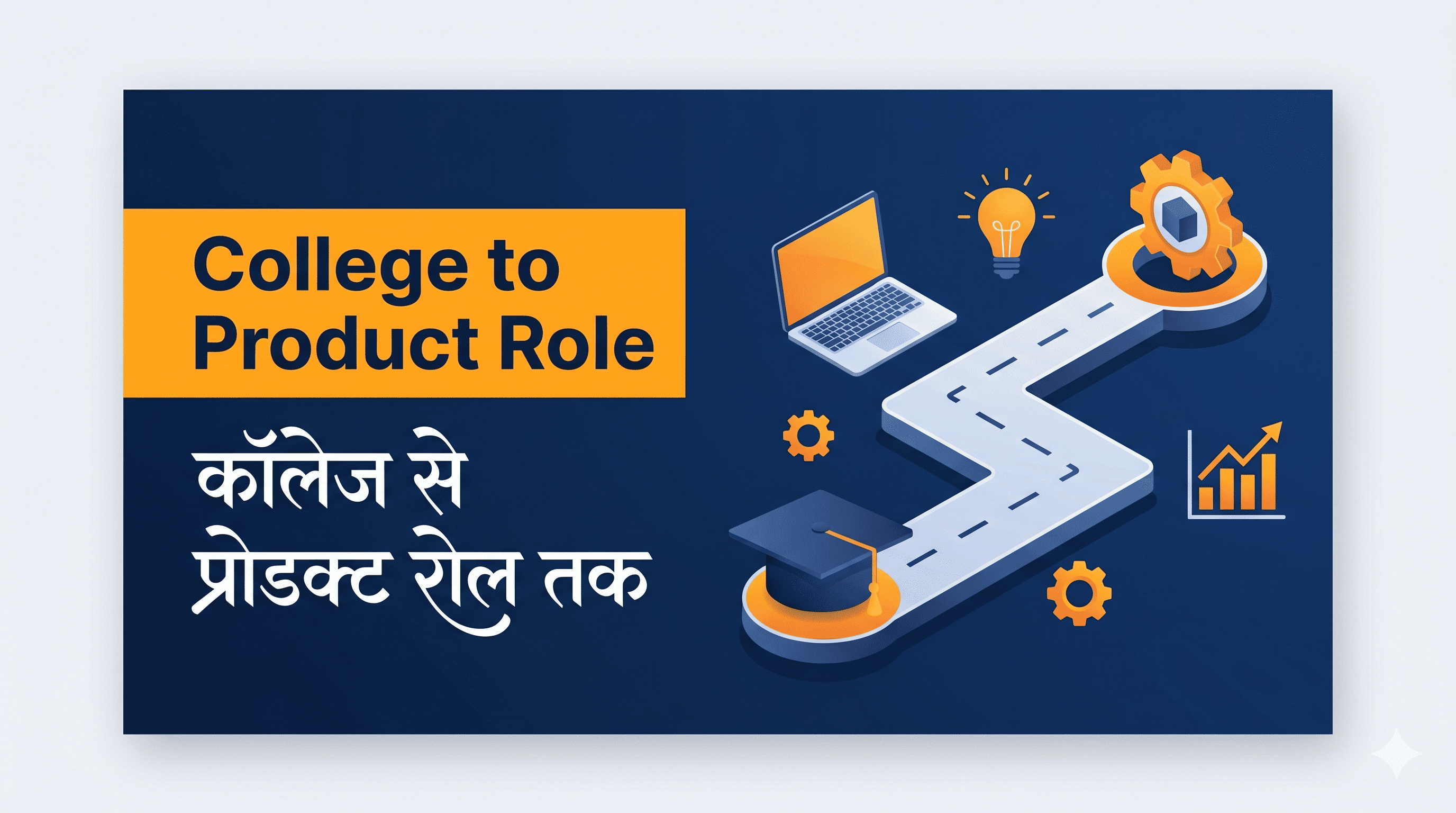
Engineering gives you the ability to build things — but product management gives you the power to decide what gets built and why. For engineers fresh out of college, transitioning into a product role is one of the most rewarding career moves available. This article lays out a clear, actionable roadmap to help you make that shift — from your final year in college all the way to landing your first PM offer.
What does a Product Manager actually do?
A Product Manager (PM) sits at the intersection of business, technology, and design. They are not the ones writing code — they are the ones deciding what code gets written and for what reason.
Understand user problems — through research, interviews, and data
Define what to build — write PRDs (Product Requirement Documents) and user stories
Align engineering and design — ensure everyone builds toward the same goal
Communicate with stakeholders — leadership, marketing, sales, and support teams
Measure outcomes — track metrics to see if the product is working
The PM owns the "WHAT" and "WHY." Engineering owns the "HOW."
Why engineers make strong PM candidates
Your engineering background is not a liability — it is one of your strongest assets when transitioning to product.
Technical credibility — developers take you seriously because you understand their constraints
Feasibility judgment — you can tell what is buildable without running it past engineering first
Data comfort — SQL, analytics, and metrics are not intimidating to you
Systems thinking — you naturally break big problems into smaller components
Problem-solving discipline — debugging trains you to find root causes, not symptoms
The honest truth: Technical PMs have a faster ramp-up time in their first year. The gap you need to close is on the business and empathy side — not the technical side.
Start in college — 5 things to do right now
If you are still in college or recently graduated, these steps will build your PM foundation faster than any course.
1. Analyze apps you use every day
Pick one app — Swiggy, CRED, Zepto, PhonePe — and study it like a PM. Ask yourself:
What user problem does this feature solve?
What business goal does it serve?
What would I change and why?
2. Write product teardowns
Write a 600–800 word teardown of any app and publish it on LinkedIn or Medium. This becomes your first portfolio piece and signals PM thinking to recruiters.
3. Practice case questions
PM interviews are built around case questions like "Design a new feature for WhatsApp" or "How would you improve Google Maps?" To practice:
Watch Decode PM on YouTube
Read "Cracking the PM Interview" by Gayle McDowell
Follow Shreyas Doshi and Lenny Rachitsky on LinkedIn
4. Take ownership in college projects
In your next hackathon, group project, or personal side project — take the PM role. Own the planning, prioritization, and coordination. Document what decisions you made and why.
5. Target APM programs and PM internships
Many companies run structured Associate Product Manager (APM) programs built specifically for freshers — Google APM, Microsoft Explore, Flipkart PM Intern, Meesho, Razorpay, and Swiggy all have fresher-friendly tracks.
Skills you need before your first PM role
Technical skills (you likely have these already)
Basic SQL — to pull data and answer product questions yourself
Google Analytics or Mixpanel — to understand user behavior
Figma basics — to sketch wireframes during discussions
Business skills (build these now)
Market sizing — understanding TAM, SAM, SOM
Prioritization frameworks — RICE score, MoSCoW, Kano model
OKRs and KPIs — how goals are set and measured at companies
User research methods — interviews, surveys, usability testing
Soft skills (the hardest to build, most important to have)
Communication — simplifying complex ideas for non-technical audiences
Empathy — genuinely feeling the user's frustration
Influence without authority — getting teams to align when you have no direct control
Decision-making under uncertainty — acting decisively with incomplete information
Rewriting your resume and LinkedIn for a PM role
An engineering resume will not get you a PM interview. You need to reframe your experience in product language.
How to rewrite your resume bullets
Old: "Built the payment module using React and Node.js"
New: "Identified checkout drop-off as the key friction point, defined requirements for a redesigned payment flow, and shipped it — reducing drop-off by 22%"
Add metrics wherever possible. Outcomes matter more than technologies used.
LinkedIn profile tips
Headline: "Engineer transitioning to Product | User-first thinking, technical depth"
About section: 3–4 lines explaining why you want to move into product — be specific and honest
Post your teardowns and case studies regularly — visibility matters
Where to find your first PM job
The best routes for freshers
APM programs — Google, Microsoft, Flipkart, Meesho, Razorpay, Swiggy — apply 6 months in advance
Early-stage startups — smaller teams mean broader responsibility and faster learning
Internal transfer — if you are already at a tech company as an engineer, request a PM rotation
Internship to full-time conversion — a PM internship with a return offer is the cleanest path
Product communities — PM School, Product Space, and Reforge have job boards and referral networks
Reality check: The first PM role is the hardest to get. After 12–18 months of experience, opportunities open up significantly. Do not wait for the perfect company — take the role that gives you real ownership.
How long does the transition take?
Your situation | Preparation timeline |
|---|---|
Final year of college | Start 6–8 months before graduation |
Recent graduate, no job yet | 3–4 months of focused preparation |
Working engineer wanting to switch | 6–12 months of side preparation |
The transition from engineering to product is not a leap into the unknown — it is a natural evolution of how you already think. You understand systems, you are comfortable with data, and you know how software is built. The missing pieces are business context and deep user empathy, and both can be learned deliberately. Start today with one product teardown, and you will have your first PM portfolio piece by the end of the week.
Frequently asked questions
Do I need an MBA to become a Product Manager?
No. An MBA can help with business fundamentals and network access, but it is not required. A strong portfolio of case studies, product teardowns, and internship experience carries more weight with most hiring managers at tech companies, especially for entry-level roles.
What is the difference between an APM program and a regular PM role?
An APM (Associate Product Manager) program is a structured 1–2 year entry-level track with mentorship, rotations across product teams, and formal training. A regular PM role has immediate ownership with less hand-holding. For freshers, APM programs are the better starting point because they are designed for people without prior PM experience.
Can a non-CS engineer become a Product Manager?
Absolutely. Mechanical, electrical, civil — any engineering discipline builds the analytical and systems-thinking foundation that makes a good PM. The technical depth matters less than your ability to understand user problems and communicate across teams. Many successful PMs come from non-CS backgrounds.
Written by
Jayesh Gavit
IT Engineer & Content Creator, JGblogs
IT engineer with a passion for technology and building things. Started JGblogs in 2026 to share information and make government schemes, jobs, and career guides accessible to every Indian — free, in their own language.
About the author →Article
Related articles
How to Get Your First Cybersecurity Job in 2026: Complete Beginner Roadmap
7 June 2026·1,250 views
Jobs That May Grow Fast in India by 2030: Top Careers, Skills, Salary & Future Trends
24 May 2026·1,250 views